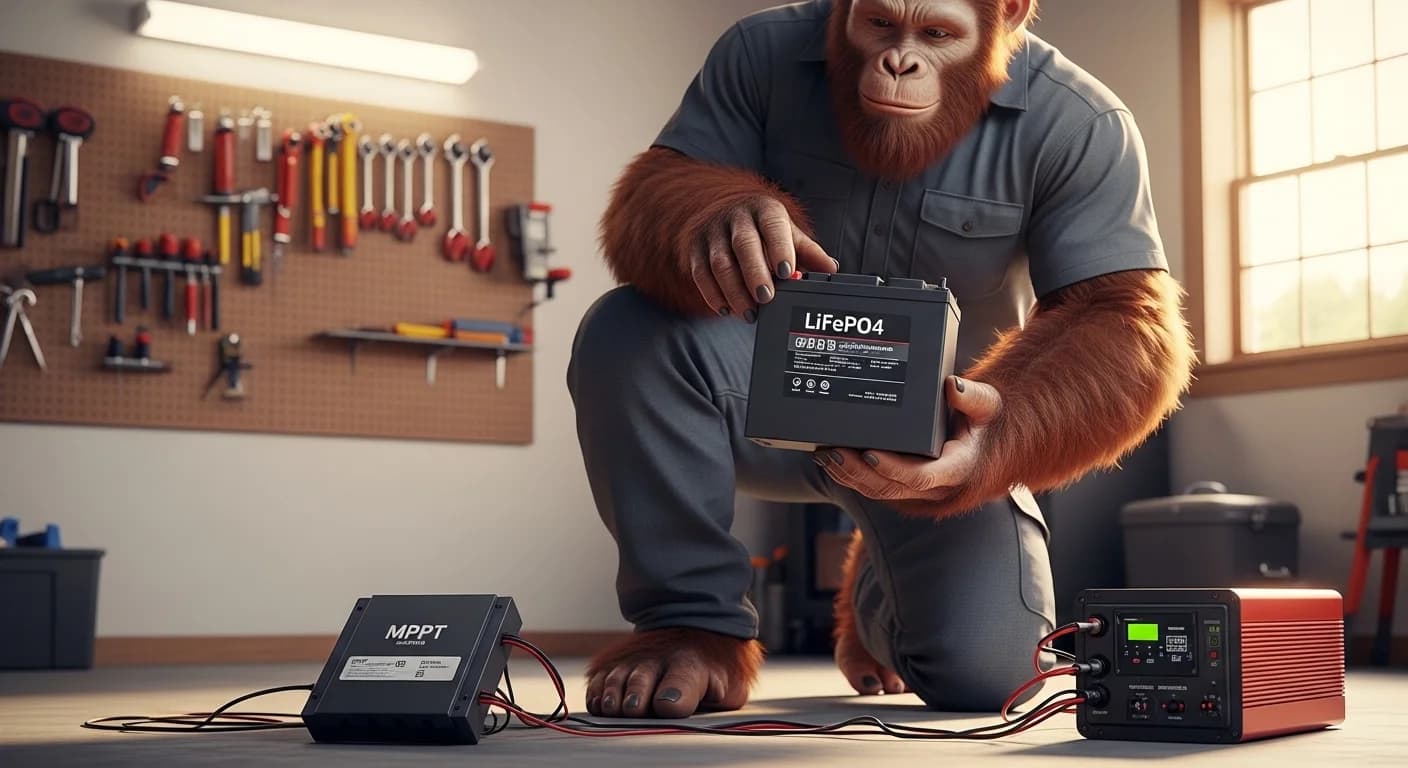
TL;DR — Best portable solar panels for beginners
The best portable solar panels for first-time buyers are 100W monocrystalline foldable units paired with a portable power station. Renogy 100W delivers the strongest value-to-quality ratio. Jackery SolarSaga 100W is the easiest plug-and-play option. Goal Zero Boulder and Nomad series occupy the premium tier with rugged construction. Anker SOLIX panels handle the whole-house tier when stacked. Match watts to use case: 100W for weekend camping, 200-400W for emergency backup, 600-1,000W for cabin power. Quality panels last 10-25 years.
Ray bought his first portable solar panel two weeks before his daughter's first camping trip. A 60-watt foldable from a brand he'd never heard of. The reviews on the listing looked good. The price was lower than the name brands. He plugged it into his phone at the campsite. Two hours of full sun. The phone gained 14 percent. He drove home and ordered a Renogy 100W on Tuesday morning. Same trip the next month, full phone charge in forty-five minutes. Tablet charged in two hours. CPAP machine ran for three nights through his wife's portable power station. The cheap panel sits in his garage with the price tag still attached. The best portable solar panels aren't cheap. They aren't expensive either. They're the right wattage with the right cell technology and a brand whose warranty paper means something.
Who this is for
This guide is for the dad in Boise taking his kids car-camping for the first time and wanting to keep the phone alive. The Florida homeowner who watched Hurricane Ian knock out power for nine days and decided next time the kids' tablets would still work. The retired schoolteacher in Vermont who wants reliable backup for her insulin and her well pump during the inevitable ice storm. The RV boondocker in Arizona running solo for two weeks at a stretch. The veteran in Oklahoma whose CPAP needs uninterrupted power through tornado season. The new homesteader in Tennessee testing solar at small scale before committing $20,000 to a roof array. The young couple in Pennsylvania renting an apartment who can't install rooftop but want emergency preparedness. The truck camper in Colorado who refuses to listen to a generator at 6 AM. The Texas family that lost a freezer of meat during the 2021 freeze and won't lose another one.
For years, portable solar was a hobbyist toy.
For years, "solar generator" meant a $2,000 brick that ran a small fan for three hours.
For years, buying a portable panel meant gambling on a no-name brand from a marketplace listing.
For years, the technology wasn't there.
The technology is here now. The brands are real. The warranties hold up. The best portable solar panels in 2026 cost a third of what they cost in 2018 and produce twice the power.
What portable solar panels actually do
The best portable solar panels convert sunlight into DC electricity you can use anywhere the sun shines. They fold or roll for transport. They weigh five to twenty pounds depending on wattage. You set them up in fifteen seconds — unfold, prop against a wall or a kickstand, plug in.
Unlike rooftop arrays, portable panels travel with you. The same 100W panel that charges your phone at the campsite also charges your power station during a blackout. The same 200W panel that runs your RV refrigerator also keeps your fridge alive during the hurricane.
Most of the best portable solar panels output 50W to 400W. A 100W panel produces enough power to fully charge a smartphone from dead in about ninety minutes of direct sun. A laptop takes three to four hours. A small power station (500Wh) reaches full charge in five to seven hours.
Monocrystalline silicon cells (the dominant technology in quality portable panels) typically operate at 18-22% efficiency under standard test conditions. Polycrystalline cells run 13-17%. The efficiency difference compounds across long usage and matters most in low-light conditions.
Who buys portable solar panels
Campers and RVers keep devices charged without hookups, generators, or fuel stops. Most state and national parks don't allow generator use after 10 PM. Solar runs silent.
Emergency preppers maintain power through outages without storing gasoline or running a noisy generator at 3 AM. A 200W panel plus a 1,000Wh power station keeps a fridge, lights, internet, and phones running through a 12-hour blackout.
Off-grid beginners test solar at small scale before committing to a permanent rooftop array. The portable system that taught you sizing math also serves as your backup forever.
Outdoor workers charge tools and devices at job sites without extension cords or generators. Contractors, ranchers, surveyors, search-and-rescue teams.
Apartment dwellers get emergency preparedness without landlord permission. Panels live in the closet. Setup takes thirty seconds when the power dies.
WATTSON'S BEGINNER TRUTH: A portable solar panel alone is a daytime-only solution. The sun goes down, the power stops. The math doesn't work unless you pair the panel with a power station. The panel charges the battery during the day. The battery runs your gear all night. That combination — panel plus storage — is what creates real energy independence. Don't buy panels without thinking about where the energy lands when it leaves the cells.
Types of portable solar panels
Three meaningful categories. Pick based on your use case.
Rigid vs foldable
| Feature | Rigid Panels | Foldable Panels |
|---|---|---|
| Efficiency | Higher (18-22%) | Slightly lower (15-20%) |
| Durability | Very durable | Good with care |
| Weight | Heavier (15-30 lbs at 100W) | Lighter (4-10 lbs at 100W) |
| Portability | Bulky, awkward | Compact, briefcase-style |
| Best for | RV mounting, permanent placement | Camping, emergency kit, travel |
| Price | Lower per watt | Slightly higher per watt |
Most beginners want foldable. Rigid is for RV roofs or permanent installation where you'll never move the panel.
Monocrystalline vs polycrystalline
Monocrystalline cells are cut from a single silicon crystal. Higher efficiency. Better in low light. Dark black color. Slightly more expensive.
Polycrystalline cells are made from melted silicon fragments. Lower efficiency. Less effective in low light. Blue color. Slightly cheaper.
The best portable solar panels in 2026 are monocrystalline. The price gap closed years ago and the performance advantage stays. Any guide recommending polycrystalline as the best portable solar panels is using outdated information.
Standalone vs power station kit
Standalone panels plug directly into MC4-compatible devices. You add the power station, the charge controller, the cables separately. More flexibility, more complexity.
Power station kits bundle a panel with a matching battery pack and an integrated charge controller. Plug the panel into the power station, plug your devices into the power station, done. Less flexibility, near-zero complexity.
Beginners want kits. Anyone building a real off-grid system wants standalone components.
What size you need
Wattage on the best portable solar panels matches use case. Bigger isn't always better — bigger costs more, weighs more, and takes longer to set up.
| Use Case | Panel Wattage | Pairs With |
|---|---|---|
| Phone + laptop charging only | 50-100W | Small power station (300-500Wh) |
| Weekend camping family | 100-200W | Mid power station (500-1,000Wh) |
| Emergency home backup (essentials) | 200-400W | Large power station (1,000-2,000Wh) |
| RV full-time | 200-400W | RV battery bank (1,000-2,000Wh) |
| Off-grid cabin testing | 400-600W | Multi-battery setup (2,000-5,000Wh) |
| Whole-home backup | 800-1,600W | Hybrid inverter + bank (5,000+Wh) |
A 100W panel produces 400-600 Wh per full sun day. A 400W panel produces 1,600-2,400 Wh per full sun day. Cloudy days drop output by 50-80%. Winter latitudes drop output by 30-50%.
Top picks: the best portable solar panels for each use case
The best portable solar panels for each use case earned their spots through actual field testing, not press releases.
Renogy 100W Monocrystalline Foldable — Best Value
The default recommendation for first-time buyers. Renogy delivers quality at a reasonable price with a real warranty backed by US support.
- 100W rated output, 21% efficiency
- Foldable briefcase design with built-in kickstands
- MC4 connectors for power station compatibility
- 5-year warranty
- Best for: weekend camping, emergency backup, off-grid testing
Jackery SolarSaga 100W — Best for Absolute Beginners
The simplest plug-and-play option. Designed specifically to pair with Jackery power stations. No cables to figure out, no charge controller to source.
- 100W rated output, 23% efficiency
- DC8mm connector (Jackery proprietary)
- Splash-resistant
- Folds in half with carrying handle
- Best for: Jackery power station owners, first-time solar buyers
Goal Zero Boulder Series — Best Premium
Rugged tempered glass panels in aluminum frames. Built for hard use. Higher price reflects construction quality.
- 100W to 200W options
- Tempered glass face with anti-reflective coating
- Aluminum frame with corner reinforcement
- Compatible with Goal Zero Yeti power stations
- Best for: serious campers, RV permanent mounting, harsh conditions
Anker SOLIX PS400 — Best Whole-House Pairing
Larger panel designed to feed the Anker Solix F3800 home backup system. Stack multiple panels for serious wattage.
- 400W rated output
- Foldable five-panel design
- 23% efficiency
- IP67 weather resistance
- Best for: pairing with Anker F3800, whole-house emergency backup
Bluetti PV200 — Best Mid-Range Premium
Solid 200W foldable. Wider compatibility than Jackery. Stronger build than budget brands.
- 200W rated output, 23.4% efficiency
- ETFE coating for durability
- Works with most power stations via MC4 + adapters
- IP65 weather resistance
- Best for: family camping, emergency kits, RVs
Comparison chart
| Panel | Wattage | Efficiency | Weight | Warranty | Best For |
|---|---|---|---|---|---|
| Renogy 100W | 100W | 21% | 11 lbs | 5 years | Beginners, budget |
| Jackery SolarSaga 100W | 100W | 23% | 9 lbs | 3 years | Plug-and-play |
| Goal Zero Boulder 100 | 100W | 18% | 20 lbs | 1 year (panels) | Rugged use |
| Bluetti PV200 | 200W | 23.4% | 16 lbs | 2 years | Family camping |
| Anker SOLIX PS400 | 400W | 23% | 38 lbs | 2 years | Home backup |
Panels. Batteries. Inverter. Charge controller.
Four components do all the work. Pick the wrong one and the whole system underperforms. The component guide walks specs that matter and specs that are marketing.
COMPARE COMPONENTS →Get the Free Solar Buyer Checklist
Every question to ask before buying any solar component — panels, batteries, inverters, and charge controllers. Free download.
GET THE FREE BUYER CHECKLIST →How to pair best portable solar panels with a power station
The best portable solar panels without storage are half a system. Here's how to match them correctly.
Match the voltage
Most portable panels output 12V to 60V DC depending on size. Power stations accept different voltage ranges. Check the spec sheet on both before buying.
Common mismatches:
- 100W panel (18V output) → most power stations: works
- 200W panel (24V output) → small power stations rated 12V: damages the input
- 400W panel (48V output) → most power stations: requires high-voltage input model
Match the connector
Most quality panels use MC4 connectors (industry standard). Some power stations use proprietary connectors (Jackery DC8mm, EcoFlow XT60, Goal Zero Anderson). Use adapter cables to bridge between standards.
Match the wattage
Power stations have a max solar input rating. A 1,000Wh power station rated for 200W solar input cannot accept a 400W panel — the panel works, but the station only uses 200W and clips the rest.
For maximum charging speed, match your panel wattage to the power station's max solar input.
The first-time buyer formula
For 90% of first-time buyers:
100W foldable panel + 500-1,000Wh power station
That combination covers weekend camping, weekend emergency outages, and most off-grid testing scenarios. Total cost: $400-$800. Payback comes the first hurricane.
The 5 mistakes first-time buyers make
Buying the best portable solar panels means avoiding these five mistakes. They cost real money.
Mistake 1: Buying the cheapest panel on the marketplace
The $50 100W panel rarely produces 100W. Most no-name panels produce 60-70% of rated output and degrade fast. Stick with named brands that publish efficiency specs and honor warranties.
Mistake 2: Skipping the power station
A panel without a battery is a daytime-only solution. The sun sets, the power stops. Pair every portable panel purchase with at least a modest power station.
Mistake 3: Buying polycrystalline to save $40
Monocrystalline costs 10-20% more and delivers 30-40% more usable power in low-light and partial-shade conditions. Always buy monocrystalline.
Mistake 4: Oversizing the panel
A 400W panel feeding a 500Wh power station wastes 70% of the panel's capacity. Match wattage to your actual storage and load. Bigger isn't better when most of it gets clipped.
Mistake 5: Forgetting the angle
Solar panels produce maximum power when perpendicular to the sun. A panel laid flat on the ground produces 60-70% of rated output. Use the built-in kickstands. Adjust the angle as the sun moves. The same panel produces 40% more power positioned correctly.
Frequently asked questions
What's the best portable solar panel for beginners? The Renogy 100W foldable monocrystalline panel is the default recommendation. Strong build quality, real warranty, fair price, MC4 connectors that work with almost any power station. Jackery SolarSaga 100W is the alternative if you want absolute plug-and-play simplicity with a Jackery power station.
How long do portable solar panels last? Quality monocrystalline panels last 10-25 years with minimal degradation (0.5-0.8% per year). Cheap no-name panels often fail within 1-3 years. Buy a brand whose warranty extends past your camping retirement.
Do portable solar panels work on cloudy days? Yes, but at reduced output. Heavy overcast drops output to 10-30% of rated. Light cloud cover reduces output to 50-70%. Rain effectively stops production. For emergency backup, oversize the panel to compensate for bad weather.
Can I charge a power station with portable solar? Yes, this is the standard pairing. Match the panel voltage to the power station's input range, use compatible connectors (usually MC4 or adapter cables), and stay within the station's max solar input rating.
How many watts of solar do I need for emergency backup? For essential loads (fridge, lights, internet, phones) during a 1-2 day outage, 200-400W of solar paired with 1,000-2,000Wh of storage covers most homes. For extended outages or whole-home backup, 800-1,600W of panels and 5,000-10,000Wh of storage.
Are foldable solar panels durable? Quality foldable panels with reinforced corners and weatherproof coatings hold up to years of use. Bargain panels delaminate or crack within a season. Look for IP65 or better weather rating and rated cycle counts above 1,000 unfold-fold cycles.
Can portable solar panels charge phones directly? Some models include USB outputs that charge phones directly. Most quality panels output DC through MC4 connectors and require a power station or charge controller between the panel and the phone. Direct charging is fine for occasional use; inconsistent panel output can stress phone batteries over time.
What's the difference between portable and rooftop solar? Portable panels travel with you and produce 50-400W per panel. Rooftop arrays mount permanently and produce 4,000-12,000W typical residential. Portable is for camping, emergencies, and testing. Rooftop is for primary home power.
Do I need a charge controller with portable solar panels? If you connect a panel directly to a battery, yes — a charge controller is required to prevent overcharging. If you use a power station, the controller is built in. Most beginner setups use power stations with integrated controllers.
How much do best portable solar panels cost? Quality 100W panels cost $150-$300. 200W panels cost $300-$500. 400W panels cost $500-$800. Brand-name premiums (Goal Zero, Jackery) add 30-50% over Renogy and similar value brands. Avoid panels priced below $1.50 per rated watt — they almost never deliver rated output.
Conclusion
The best portable solar panels solve a specific problem: power where there isn't any. Camping. Emergencies. Off-grid testing. Apartment-dweller backup. Worksites without hookups.
Match wattage to use case. 100W for weekend camping. 200-400W for emergency backup. 600-1,000W+ for cabin or whole-home use. Always pair the best portable solar panels with a power station so the energy lasts past sundown.
Stick with named brands — Renogy for value, Jackery for plug-and-play, Goal Zero for ruggedness, Anker for whole-home, Bluetti for mid-range. Skip the $50 marketplace panels. The math on cheap solar is always worse than it looks.
Monocrystalline always. Foldable usually. MC4 connectors when possible. Real warranties from companies with US phone numbers. That's the formula for the best portable solar panels.
The next outage is coming. The next camping trip is coming. The next blackout is coming. The right portable panel costs $200-$500 and lasts a decade. The wrong panel costs $80 and gets used once.
The complete Component Selection guide →