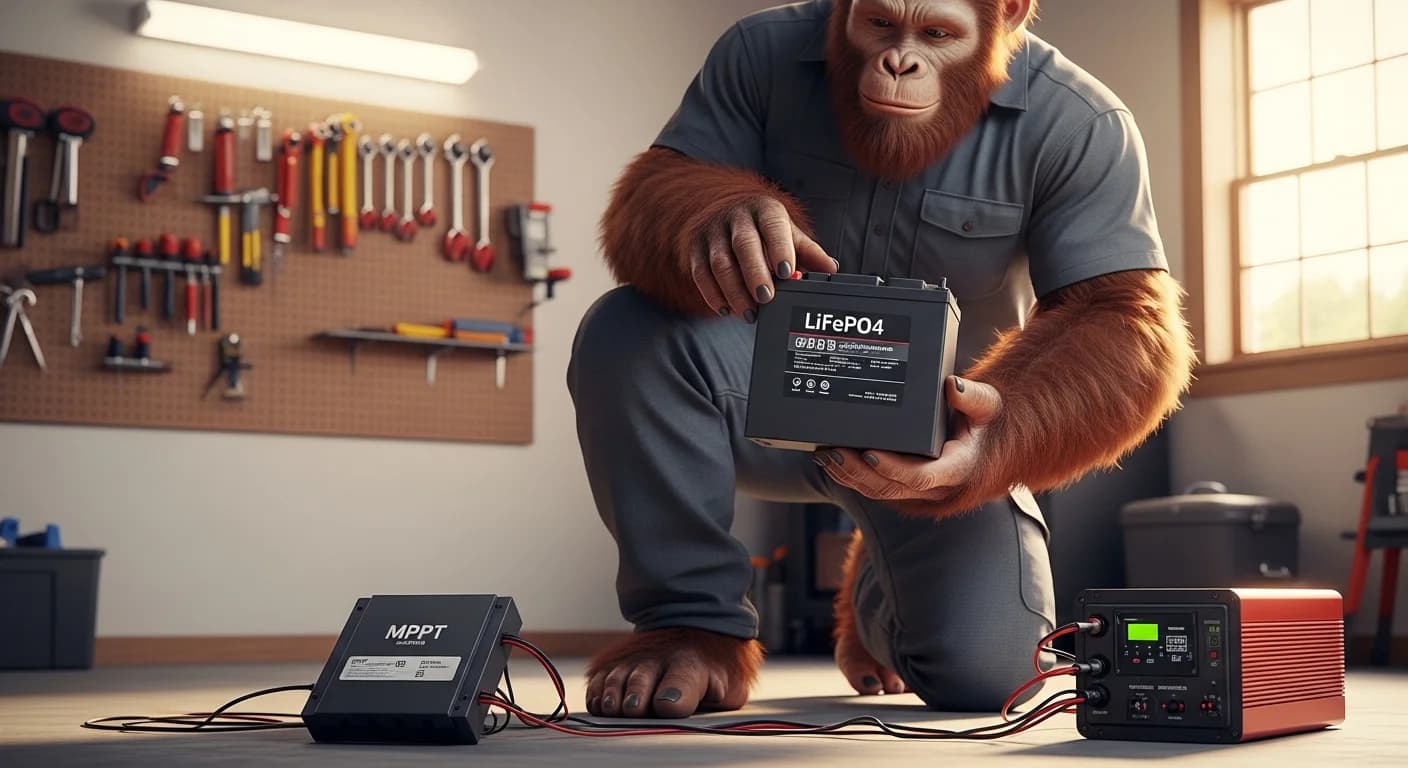
Solar Basics.
Off-grid solar requires six essential components working together: panels, charge controller, battery bank, inverter, monitoring system, and proper wiring. Get any one of them wrong and the others cannot save you.
GET THE FREE SOLAR CALCULATORTL;DR: The Core Intel
add
This pillar covers every fundamental of off-grid solar — system sizing, component selection, wiring basics, and the most common mistakes that cost people thousands. It is for the rancher in East Texas who is done writing checks to a utility that cannot explain his bill, the veteran building a home that answers to no one, and the father who watched Texas freeze and swore his family would never sit in the dark again.
- A complete off-grid system costs $15,000–$45,000 for most homes — DIY saves 40–60%
- US power outages have increased 150% since 2015 (U.S. Department of Energy)
- LiFePO4 batteries last 4,000–6,000 cycles — more than triple lead-acid
- MPPT charge controllers harvest 25–40% more energy than PWM
- System payback is typically 7–12 years — then 20+ years of free power
Main takeaway: Know your load before you buy a single panel. Every expensive mistake in solar starts with guessing.
Complete Solar Basics Learning Path
menu_open
In 2011, I paid a contractor $15,000 to build me a solar system. He undersized everything. The system blew up every time I plugged in a kettle. In a year, the batteries literally melted. I flew to Florida, trained at the US Solar Institute, and rebuilt everything myself. A 16kW 48V system. The $850 monthly bill disappeared. It has not come back.
Everything in this guide came from rebuilding what that contractor wrecked. There is no theory here without field experience behind it. According to the U.S. Department of Energy, power outages have increased 150% since 2015 — infrastructure built for a different era, maintained by utilities whose business model depends on your continued dependency. The next outage is not a question of if. It is a question of whether your family will have lights on when it happens.
What off-grid solar actually is
Off-grid solar means your home generates, stores, and manages its own electricity without any connection to the utility grid. No meter. No monthly bill. No service interruption when a transformer blows forty miles away.
This is different from grid-tied solar, where your panels feed excess power back to the utility and you still depend on their infrastructure. Grid-tied systems shut down during a blackout, even when the sun is shining. Safety rules force the panels offline so they cannot energize lines that crews are working on. An off-grid system has no grid to protect, so it keeps running. The lights stay on when the neighborhood goes dark.
The homeowner in Hurricane Alley who has watched the power go out so many times he stopped counting. The rancher in East Texas watching his bill climb every quarter with no explanation. The veteran in rural Montana who refused to build a home that answered to a system he didn't control. The father in rural Tennessee who watched Texas freeze and swore never again. The 58-year-old on twenty acres who learned the hard way that the grid does not follow you off the pavement. This guide is for all of them.
The six core components every system needs
Every functional off-grid solar system has the same six components. Understanding each one before you price anything is the difference between a system that runs for twenty years and one that fails the first winter.
Solar panels
Convert sunlight to DC electricity. Rated in watts. Typical residential panels run 300–450W. Output depends on sun hours and tilt angle.
Charge controller
Regulates power from panels to batteries. Prevents overcharging. MPPT is the only acceptable choice for systems over 400W.
Battery bank
Stores energy for use when panels aren't producing. Capacity measured in kWh. LiFePO4 is the standard for serious off-grid systems.
Inverter
Converts stored DC power to AC power for household use. Pure sine wave only — never modified sine wave. Size to handle your peak load.
Monitoring system
Tracks solar production, battery state, and load draw in real time. Not optional. You cannot manage a system you cannot see.
Wiring and safety hardware
Fuses, breakers, disconnect switches, wire gauge matched to current load. This is where amateur installs fail and where fires start.
Every expensive failure — including mine with the contractor — comes from one of these six components being wrong. Undersized batteries. Wrong charge controller type. Under-rated inverter. Incorrect wire gauge. The system is only as strong as its weakest component.
How to size your system — load calculations first
System sizing starts with your load — what you need to power, for how long, every day. Most people start with panels. That is backwards. Panels are determined by battery size. Battery size is determined by load. Load is determined by what you run.
List every appliance. Find its wattage. Estimate daily hours of use. Multiply wattage × hours = daily watt-hours. Sum all appliances. That is your baseline daily load in watt-hours.
Sum of all appliances = total daily load (Wh)
Total daily load ÷ system voltage = daily amp-hours (Ah)
Daily Ah × days of autonomy ÷ depth of discharge = battery bank size (Ah)
Total daily load ÷ peak sun hours ÷ system efficiency = panel array size (W)
Example: A modest off-grid home pulling 3,000Wh per day needs roughly a 15kWh battery bank (assuming 50% usable depth on LiFePO4, two days autonomy). That requires approximately 3,000–4,000W of panels — 8–12 panels at 350W each. Run the calculator before you price anything.
System voltage — 12V, 24V, or 48V
System voltage is the operating voltage of your battery bank. It affects wire sizing, inverter options, charge controller compatibility, and system efficiency. Choose wrong and you are retrofitting expensive hardware later.
The physics favor higher voltage: lower current for the same power level means smaller, cheaper wire and lower resistance losses over distance. For any homestead running significant loads — well pump, HVAC, refrigeration — 48V is not a recommendation. It is the only sensible choice.
Battery chemistry — LiFePO4 vs lead-acid
The battery bank is where most beginner systems fail and where most expensive mistakes happen. Battery chemistry determines how long your system lasts, how much you can actually use, and what it costs per kilowatt-hour over the system's lifetime.
| Spec | LiFePO4 | Flooded Lead-Acid | AGM Lead-Acid |
|---|---|---|---|
| Cycle life | 4,000–6,000 cycles | 1,200–1,500 cycles | 400–600 cycles |
| Usable capacity | 80–100% | 50% (max) | 50% (max) |
| Weight (100Ah, 12V) | ~30 lbs | ~65 lbs | ~60 lbs |
| Temperature range | -4°F to 140°F | 32°F to 100°F ideal | 32°F to 100°F ideal |
| Maintenance | None | Monthly water checks | None |
| Lifespan | 10–15 years | 3–5 years | 4–7 years |
| Cost per kWh (lifetime) | Lowest | Highest after replacement | High |
The math is not complicated. LiFePO4 costs more upfront. It lasts four times longer. You replace lead-acid two to four times over the life of one LiFePO4 bank. The cheap option is usually the expensive option over a ten-year window.
The Battle Born 100Ah LiFePO4 is the battery Wattson rebuilt his own system with. Check current pricing and availability on Amazon.
If budget forces lead-acid in year one, build for the upgrade. Size your battery box, charge controller, and inverter for LiFePO4 from the start so the swap is a swap — not a redesign.
Charge controllers — MPPT vs PWM
The charge controller sits between your panels and your battery bank. Its job is to convert panel output to the voltage and current your batteries need without overcharging them. Two technologies exist. One is worth buying.
PWM (Pulse Width Modulation) is the older, cheaper technology. It directly connects the panels to the battery when the battery needs charging and disconnects when full. Simple but wasteful — any panel voltage above battery voltage is thrown away as heat.
MPPT (Maximum Power Point Tracking) continuously finds the panel's optimal operating point, converts the excess voltage into additional charging current, and delivers 25–40% more energy from the same panels. According to the National Renewable Energy Laboratory (NREL), MPPT controllers can increase energy harvest by up to 30% in real-world conditions.
Use MPPT for any system over 400 watts. The efficiency gains pay for the cost difference in less than a year.
The Victron SmartSolar MPPT is Wattson's charge controller of choice — field-proven across thousands of off-grid installations, with real-time Bluetooth monitoring and a track record in harsh conditions. Check current pricing on Amazon.
The Morningstar ProStar MPPT is the workhorse alternative — simpler than Victron, reliable in extreme temperatures, and a solid choice for systems where you want proven simplicity over advanced features. Check current pricing on Amazon.
Check Amazon for current pricing on solar charge controllers →
Inverter selection — pure sine wave only
The inverter converts DC power from your battery bank into the AC power your household appliances use. It is the gateway between your stored energy and everything you plug in.
Never buy a modified sine wave inverter for a residential off-grid system. Modified sine wave outputs a stepped approximation of AC power that damages sensitive electronics, runs motors hotter, reduces motor lifespan, causes refrigerant compressors to cycle incorrectly, and interferes with audio and medical equipment. The cost savings are not worth the equipment damage over time.
Pure sine wave inverters output clean AC power identical to grid power. Every quality appliance — refrigerators, well pumps, tools, medical equipment, electronics — operates correctly on pure sine wave. There is no legitimate reason to choose modified sine wave for a permanent off-grid installation.
Size your inverter to your peak load plus 25% buffer. A homestead running lights, refrigerator, and basic electronics needs a 2,000–3,000W pure sine wave inverter. Add a well pump or HVAC and you need 5,000–8,000W. The AIMS Power pure sine wave inverter and Victron MultiPlus are the field-tested standards for North American off-grid installations.
Wiring, fusing, and electrical safety basics
Wiring is where most amateur installations fail. Not because people do not know how to make connections — because they use undersized wire, skip fusing, or wire the system in a configuration that accumulates dangerous heat over years of use.
Wire gauge is determined by current (amperage), not voltage. Higher current requires heavier gauge wire. Use NEC Article 690 wire sizing tables for DC circuits, not the simplified charts that appear in solar installation blogs. The consequences of undersized wire are not immediate failure — they are slow thermal degradation that creates fire risk months or years later.
- Every circuit must have overcurrent protection (fuse or breaker) within 18 inches of the battery positive terminal
- Wire gauge must be rated for at least 125% of the circuit's maximum continuous current
- All DC connections must be torqued to specification — loose connections arc, arc causes fires
- Battery bank must have a main disconnect switch accessible without reaching over batteries
- All outdoor wire runs must be rated for UV exposure and the temperature range of your climate
- Grounding: system must be properly grounded per NEC Article 690 for solar systems
The NEC Article 690 covers photovoltaic systems specifically. Read it. This is the one area where cutting corners puts your family's physical safety at risk — not just your budget.
The most expensive beginner mistakes
Every mistake in this list cost someone money, time, or both. Most are preventable with a load calculation and thirty minutes of reading before the first purchase.
01. Buying equipment before you run the numbers
The exciting part is the gear. So beginners buy panels first, then size the system around what they already own. That is backward. You calculate the load, then the battery bank, then the panels to refill it. Buy in that order. Equipment bought before the math almost never fits the system you actually needed. Run the load calculation first.
02. Building a patchwork system to save money
Mixing mismatched panels, a bargain controller, and whatever batteries were on sale feels frugal. It is not. Components that are not matched fight each other. A panel string that does not match the controller's voltage window loses harvest every day. The cheap part does not save money. It drags down everything wired to it.
03. Undersizing the battery bank
The most common and most expensive mistake. A too-small battery bank is discharged deep every night, dramatically shortening its life. A lead-acid bank discharged below 50% regularly will last two to three years instead of five. Size for two to three days of autonomy without solar input.
04. Buying a PWM controller for a large system
A PWM controller on a 2kW+ system wastes 25–40% of your solar harvest every day. Over a year that represents thousands of watt-hours of energy you paid for in panels and never used. MPPT is not a luxury for large systems | it is the correct specification.
05. Using the wrong system voltage
A 12V system at residential load levels requires wire so heavy it becomes impractical. Every ampere of capacity added to a 12V system is four times the cost in copper compared to a 48V system for the same power output. Design at 48V from the start.
06. Trusting a contractor who oversells panels and undersizes batteries
Contractors make margin on panels, not batteries. A system with too many panels and too few amp-hours will fail during cloudy periods and overcharge the bank on sunny days. The Solar Calculator tells you the right ratio before you sign anything.
07. Ignoring shading
A single shaded cell on a panel can reduce the output of the entire panel by 30–75% depending on the bypass diode configuration. Shade analysis before mounting is not optional.
08. Skipping monitoring
You cannot manage what you cannot measure. A system without real-time monitoring of battery state, panel output, and load draw is flying blind. Basic monitoring systems cost $150–$400 and pay for themselves immediately.
What to do after reading this
The Solar Calculator is the first tool you need. It handles the load calculation for your specific home, your state's peak sun hours, and your seasonal variation. Take the output — panel count, battery bank size, inverter spec — and use it as the starting point for every conversation with every vendor. No vendor should be able to contradict it without specific data to back up the deviation.
After the calculator, the next pillar covers system design in depth — how to lay out a system that can expand as your needs grow, how to wire for efficiency, and how to document your build so you can troubleshoot it five years from now without guessing.
KNOW YOUR LOAD. OWN YOUR POWER.
The Solar Estimator gives you exact panel count, battery bank size, and inverter spec — based on your actual home.
Supporting guides in this pillar
System design — size your system correctly
Sizing it right the first time is the difference between independence and an undersized system that fails when you need it most.
Component selection — choose equipment that lasts
The wrong component in the right slot still fails. This guide covers what to buy and what to avoid.
DIY installation — install without contractor markup
Contractor markup runs 40–60%. This guide covers what they are charging you for and how to do it yourself.
Maintenance — keep your system running for decades
The system that runs clean fifteen years from now is the one that gets checked. Here is the maintenance schedule.
Cost and ROI — real numbers and real payback timelines
No optimistic rounding. Real costs, real payback timelines, and the honest math on when independence pays for itself.
Complete off-grid FAQ — every question answered
Every question that has come up more than once. Direct answers. No sales pitch.
Frequent Interrogations (FAQ)
How much does an off-grid solar system cost?
How many solar panels do I need to go off-grid?
What is the best battery for off-grid solar?
Can I install solar panels myself without a contractor?
What is an MPPT charge controller and do I need one?
What size inverter do I need for off-grid solar?
How long will an off-grid battery bank last overnight?
What is the difference between 12V, 24V, and 48V solar systems?
Do I need permits to install solar panels off-grid?
How does off-grid solar work in winter or on cloudy days?
YOU KNOW THE BASICS. NOW BUILD YOUR ACTUAL SYSTEM.
GET THE CALCULATOR →Know your load before you buy a panel. Size your battery bank for real autonomy. Use LiFePO4 if you can afford it. Use MPPT regardless. Wire to code. Monitor everything. The families that get this right are independent. The ones that guess are paying contractors to come back and fix what should have been right the first time.
The next step is system design — how to lay out a system that grows with your needs and can be maintained without calling anyone. That is Pillar 2. Size it right the first time.