Off-Grid Lifestyle.
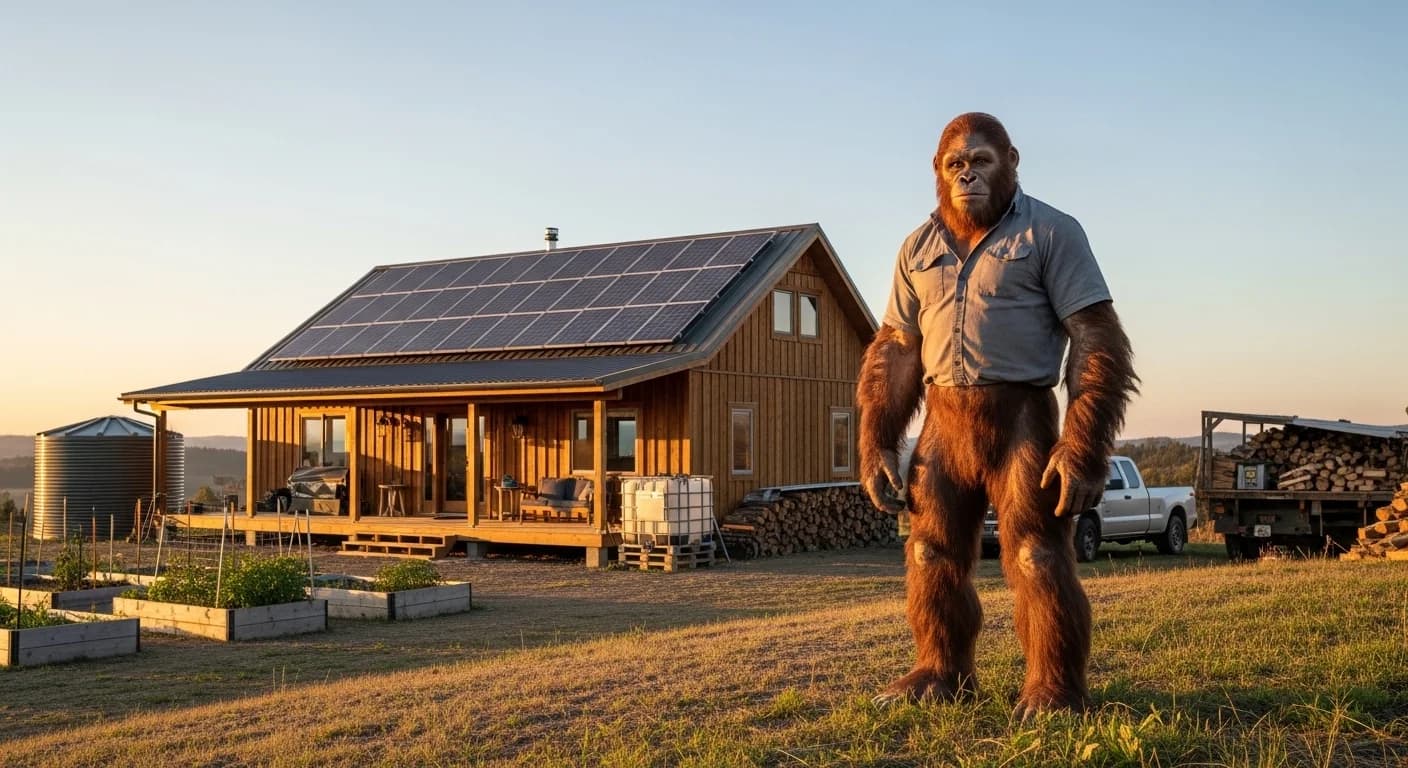
Every system running. Every dependency eliminated. The power, the water, the food, the security — all of it built by your hands, for your family, answering to no one else's grid. This is what the other side of the decision looks like.
GET THE FREE SOLAR CALCULATORTL;DR: The Core Intel
add
Pillar 12 is not an instruction manual. It is a description of the destination — what daily life looks like when all eleven preceding systems are operational, maintained, and no longer a source of anxiety. This page exists for the person who has done the work. Or the person who is deciding whether to start.
- The off-grid life is quieter than the grid life — not because it is simpler, but because the decisions were already made
- Every system built in the right order makes the next system easier — power enables water, water enables food production, food enables long-term stability
- The lifestyle does not look like deprivation — it looks like a household that runs, even when everything else doesn't
- Regulations, zoning, and building codes for off-grid living vary significantly by location — research before you build
- The complete curriculum is thirteen pillars — Pillar 13 (Financial Stability) is live on PrepperGoldIRA.com
Main takeaway: One question led to the next. It always does. Power. Water. Food. Finances. Once you see the pattern you cannot unsee it.
Complete Off-Grid Lifestyle Learning Path
menu_open
The first question was about the electric bill. That is almost always how it starts — a number on a page that feels like a tax on existing, and the thought that there must be another way. The question becomes a search. The search finds a solar calculator. The calculator produces a number. The number becomes a decision. The decision becomes a system. The system becomes a life.
This is Pillar 12. It is the finish line of a twelve-part curriculum that began with solar panels and ends with a complete picture of what independent living looks like when it is not a theory but an operating reality. If you are reading this having built the systems — power, water, food, security, tools, and the financial foundation underneath all of it — you already know what this page is about. If you are reading it at the beginning, wondering whether the work is worth it, the answer is here too.
What it actually looks like — the day-to-day of a running system
The engineer in southern Colorado who spent three years building his systems in order — solar first, then a drilled well and solar pump, then a 90-day food store, then a layered security system — and who sat down one evening and realized he could not recall the last time he had thought about what would happen if the power went out. The couple in rural Tennessee who paid off their property in nine years by eliminating the utility bill, the grocery panic, and the contractor call rate, then started helping their neighbors build the same systems because the knowledge felt too useful to keep. The family in the Texas Hill Country who lived through Winter Storm Uri with a full battery bank, a running well pump, a stocked pantry, and a warm house — while their neighbors drove to San Antonio to find hotel rooms — and who described the experience not as survival but as exactly what they had planned for. The homesteader in western Montana who has not received a utility bill since 2019 and who spends the money that used to go to the power company on the property improvements that make the system better each year. The retired couple in New Mexico who built their off-grid property to be the place the whole family comes when the grid doesn't work — not because they expected the grid to fail, but because they built something worth coming to. This is the life on the other side of the decision.
This is not a highlight reel. This is a Tuesday.
The decision — what changed, and why it was worth it
The decision to build off-grid is not made once. It is made every time a system is completed and the thing it replaces is no longer a source of anxiety. It is made when the first power outage comes and the house stays lit. When the first drilled well is tested and comes back clean. When the 90-day food store is full for the first time and the grocery store becomes a place of preference rather than necessity.
The decision is not about the grid. It is about dependence. Every system built is a specific form of dependence eliminated. The person who has built all twelve is not anti-grid — they are simply no longer at the grid's mercy.
The sequence — why order matters more than speed
Every off-grid system is interdependent. Power runs the water pump. Water enables food preservation and food production. Stored food requires powered refrigeration. Security depends on powered cameras and lighting. The workshop tools require an inverter designed for their startup surges. Building in the wrong order — food before water, security before power, lifestyle before infrastructure — produces systems that are incomplete, underpowered, and vulnerable in the moments they are most needed.
The complete curriculum — all 13 pillars
Each pillar is a complete guide to one domain of sovereign living. Read them in order or go directly to the system you are building next.
The financial reality — what off-grid living actually costs to maintain
The capital investment in an off-grid system is real. A complete solar installation, a drilled well, a cistern, a 90-day food store, a security system, and a complete tool arsenal represents a significant expenditure over two to five years. The ongoing operating cost once the systems are built is a different number — and it is the number that makes the decision financially rational over a 25-year horizon.
The annual operating delta — $15,600 to $28,000 per year in favor of the off-grid household — is the number that makes the capital investment rational. At $20,000/year in savings, a $120,000 total system build-out has a six-year payback period. At $15,000/year in savings, eight years. Every year after payback is a year where what used to go to utility companies funds what the household chooses instead.
The community — you are not the only one who made this choice
The U.S. Energy Information Administration (EIA) estimates that approximately 1.7 million US households currently generate some or all of their electricity from distributed solar systems. The number of households with battery storage has grown by over 70% in the last three years as battery costs have declined and grid reliability has become a publicly visible concern following Texas 2021, Puerto Rico 2017, and the recurring California public safety power shutoffs.
The community of people who have made this choice is not a fringe. It is a growing plurality of practical households — engineers, farmers, ranchers, veterans, retirees, young families — who looked at their utility bills, their water bills, their grocery bills, and their contractor dependency and decided the alternative was worth building. What they share is not an ideology. It is an infrastructure.
Pillar 13 — Financial Stability — is the next chapter of this curriculum and is live on PrepperGoldIRA.com — the dedicated resource for gold, silver, and financial sovereignty for families who refuse to leave their wealth in a system they don't trust.
Regulations — what off-grid living legality looks like in your location
Off-grid living exists within a legal framework that varies widely by state and county. What is actively encouraged in Texas — rainwater collection tax exemptions, no mandatory grid connection for rural residential — may be restricted or require permits in California, where grid interconnection rules, battery storage fire codes, and water collection rights interact with each other in ways that require local research before building.
Grid connection requirements
Some states and counties require new residential construction to connect to the grid even if the homeowner intends to use solar. Others have no such requirement. Know your local zoning ordinance requirement before designing an off-grid system for a new build.
Alternative dwelling structures
Tiny homes, earthships, yurts, and other alternative structures face varying legal status by jurisdiction. Some counties have embraced them with specific ADU ordinances. Others require conformance with standard building codes that effectively prohibit them.
Water collection and storage
Rainwater collection legality varies by state. Large cistern installations may require permits. Greywater reuse systems face state-specific regulations. Well drilling requires state-issued permits in most states.
Battery storage installation
Large battery banks — particularly lithium systems — are subject to fire code requirements that vary by jurisdiction. Some counties require specific setbacks, ventilation requirements, and fire suppression systems for battery installations above a certain capacity.
Food production and livestock
Keeping livestock, operating a home-based food production operation, and selling food produced on the property are each regulated differently by county and state agricultural codes. Know the rules for your intended production scale before purchasing animals or equipment.
Off-grid living regulations, zoning classifications for self-sufficient residential use, building codes for alternative dwellings, and utility interconnection requirements vary significantly by state and county. What is legal and encouraged in one rural county may require variances, permits, or be outright prohibited in the county next to it.
Wattson's AI Guide can help you identify the specific regulations, zoning classifications, and permit requirements for your exact location — before you purchase land or commit to a build plan that may conflict with local code.
Ask Wattson's AI GuideThe questions that remain — what comes after the systems are built
The systems do not end the questions. They change them. Once the utility bill is gone, the question becomes what to do with the money. Once the well is drilled and tested, the question becomes what to grow with the water. Once the tool arsenal is complete and the skills are built, the question becomes what to make with them. Once the 90-day food store is full, the question becomes whether to extend it to six months.
One question led to the next. It always does. Power. Water. Food. Finances. Security. Tools. Once you see the pattern you cannot unsee it — and the questions that come after the systems are built are better questions than the ones that came before.
What comes after the systems are built is a household that runs on its own terms. Not without effort — the systems require maintenance, the garden requires work, the animals require attention, the tools require skill. But the effort goes toward things you chose, not toward dependencies you inherited. That is the difference the systems make. It is not a small difference.
THE LIFESTYLE DEMANDS A SYSTEM. START WITH POWER.
Every other aspect of sovereign living depends on having reliable energy. The Solar Calculator tells you exactly how much your household requires.
Supporting guides in this pillar
Pillar 1 — Solar Basics: start here
Six components. One system. The foundation everything else runs on.
Pillar 2 — System Design: size before you buy
The mathematical design process that prevents expensive mistakes.
Pillar 7 — Emergency Preparedness: the complete readiness stack
Power, food, water, communications, security, and medical — all six layers.
Pillar 6 — Cost and ROI: the financial case built honestly
The 25-year total cost of ownership. The payback calculation. The real numbers.
Pillar 10 — Water Systems: three days without water ends everything
Well systems, cisterns, filtration, and the power to run it all.
Complete FAQ — every question that came in more than once
The full library of questions across all twelve pillar domains.
Frequent Interrogations (FAQ)
What does full off-grid living actually look like day to day?
Is off-grid living legal everywhere?
How long does it take to build a complete off-grid system?
What is the biggest mistake people make going off-grid?
How much does off-grid living cost to maintain annually?
What is the correct sequence for building off-grid systems?
Does off-grid living mean living without electricity or comfort?
What is the financial return on building off-grid?
What is the relationship between the 12 pillars?
Where does the OffGrid Power Hub journey go after Pillar 12?
THE COMPLETE SYSTEM. BUILT BY YOU. FOR YOUR FAMILY.
START WITH THE CALCULATOR →The journey from the first question — about the electric bill, or the water supply, or the empty shelves — to here, with all twelve systems in place and running, is not measured in months. It is measured in decisions. Each one replaced a form of dependence with a form of capability. Each one made the next decision easier. Each one is the reason, on the Tuesday when the grid goes down at 11:30 PM and comes back two days later, that the household notices nothing but the silence of the house and the charge percentage on the battery monitor.
That is what the other side looks like. The Solar Calculator is where the first decision begins. Start there.