Last Updated: April 13, 2026
TL;DR — The 10-Year Verdict
If you are building a small weekend cabin, AGM is a functional, low-cost starter option. But if you are building a permanent off-grid home, AGM is a financial trap. Because you have to buy TWO AGM batteries to get the same usable power as ONE Lithium battery (due to the 50% discharge limit), the price gap narrowing quickly. Over 10 years, a Lithium bank will save you thousands of dollars and hundreds of pounds in heavy lead-acid maintenance.
Are you looking at a $800 battery bank or a $2,500 one?
The sticker shock of Lithium is real. But before you buy the heavy lead-acid blocks, you need to understand the 'hidden taxes' of AGM: the weight, the slow charging, and the fact that you will be buying them again in four years. This guide shows you the math of actual 10-year ownership.
Table of Contents
Usable Capacity: The 50% rule vs. 100% freedom
If you buy a 100Ah AGM battery, you really only have 50Ah of usable power. If you discharge it deeper than 50% regularly, the lead plates sulfate and the battery dies within a year.
If you buy a 100Ah LiFePO4 battery, you have 100Ah of usable power.
This means a 400Ah AGM bank (costing ~$800) has the same usable energy as a 200Ah Lithium bank (costing ~$700). Suddenly, the "expensive" Lithium option is actually cheaper on day one, and avoids the rapid off-grid battery failure common with smaller, over-discharged lead-acid banks.
Cycle Life: The 3,000 cycle gap
- AGM: Typically 500 to 1,000 cycles at 50% discharge. (Roughly 3-4 years of daily use).
- LiFePO4: Typically 4,000 to 6,000 cycles at 80-100% discharge. (10 to 15 years of daily use).
You will replace your AGM bank three times before your Lithium bank even begins to show significant degradation.
The upfront cost of LiFePO4 is real — but installer experience consistently shows that lithium outlasts AGM by enough cycles that the 10-year math favors lithium in most off-grid builds.
Charging Efficiency: Why Lithium saves your panels
AGM batteries are "thirsty" but slow drinkers. As they reach 80% full, they must "absorb" the charge very slowly to avoid off-gassing. This can take 4-6 hours, meaning you waste the best sun of the day.
Lithium is a "fast drinker." It can take 100% of the charge current from your controller until it is 99% full. This means your panels don't have to work as hard, and you can reach 100% state of charge even on short winter days.
Winter Performance: The cold-weather catch
This is the one place AGM wins. Lead-acid can be charged below freezing. Lithium cannot be charged below 32°F (0°C) without destroying the cells.
If you use Lithium, your batteries must be in a heated space (inside the house or an insulated box with heat pads). If you live in a deep-freeze environment and cannot heat your battery box, AGM is your only reliable winter option.
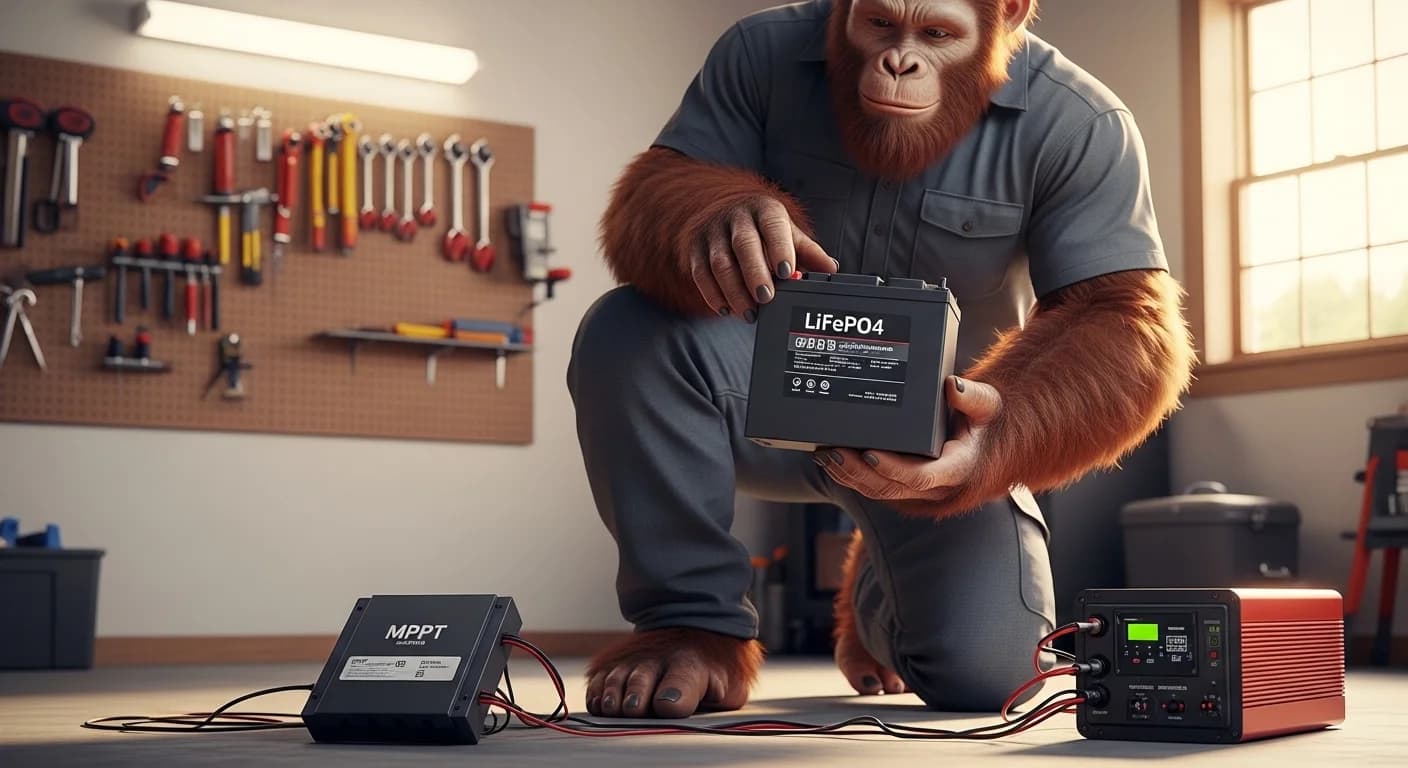
🦍 WATTSON'S BATTERY RULE: 'DON'T BUY THE SAME BATTERY TWICE.' "I've watched guys start with AGM because they were 'saving money.' Three years later, when the batteries cratered, they bought Lithium. They didn't save $800—they wasted it. If you have the cash, buy Lithium. If you don't, buy GC2 golf cart batteries. They're cheaper than AGM and last twice as long. AGM is the 'middle ground' that serves nobody well in a permanent home."
The Math: Cost per cycle comparison
| Metric | Premium AGM | LiFePO4 (Value) |
|---|---|---|
| Upfront Cost (200Ah usable) | ~$800 | ~$700 |
| Max Discharge | 50% | 100% |
| Cycles | 800 | 4,000 |
| Total Lifetime Energy (kWh) | 1,920 kWh | 9,600 kWh |
| Cost Per kWh | $0.42 | $0.07 |
The math is clear: Lithium is 6 times cheaper than AGM over the life of the system.
Stop Buying the Wrong Battery
The Solar Buyer Checklist includes the internal cycle-life comparison and the top 3 'Value Lithium' brands Wattson uses to save money without sacrificing quality.
Get the solar buyer checklist →The homesteader in Idaho watching his winter production crater. The veteran in Michigan who refuse to be dependent on a grid that fails. The father in Tennessee who knows his family's safety depends on his gear. This guide is for them.
Frequently Asked Questions
Is LiFePO4 better than AGM for off-grid solar?
Yes, in almost every way. LiFePO4 is lighter, lasts 4-6 times longer, and can be discharged to 100% without damage. The only disadvantage of lithium is its inability to charge in freezing temperatures without a heating system.Can I replace AGM batteries with Lithium?
Yes, but you must ensure your charge controller and inverter have a 'Lithium' or 'LiFePO4' charging profile. Lithium requires a different charging voltage and sequence than lead-acid to prevent BMS (Battery Management System) shut-offs.Why is Lithium so much lighter than AGM?
Lithium-ion chemistry has a much higher energy density than lead. A 100Ah Lithium battery weighs about 25-30 lbs, while a 100Ah AGM battery weighs 65-75 lbs. For a large bank, this is the difference between 300 lbs and 1,200 lbs on your floor joists.Do I need a special charger for Lithium batteries?
Yes. You must use a charger that supports LiFePO4 charging profiles. Standard lead-acid chargers often use a 'desulfation' or 'equalization' pulse that can damage the Lithium BMS or cause the battery to disconnect for safety.How do I keep my Lithium batteries warm in winter?
Most off-grid Lithium users install their batteries inside the living space. If they are in a shed, you can use 12V adhesive heat pads controlled by a thermostat that kick on as the temperature drops toward 35°F.The price of freedom is paid over 10 years.
Don't be the man who builds a system and then lives in constant fear of his battery voltage drop. AGM is a temporary fix for a permanent life. If you are serious about independence, invest in Lithium Iron Phosphate, specifically the high-value lithium server rack batteries that have revolutionized off-grid storage costs. It is cheaper, lighter, and more efficient. It is the heart your home deserves.
🦍 WATTSON ON WEIGHT: "I once had to help a guy move a 1,500 lb bank of expired AGM batteries out of a basement. My back has never forgiven me. We replaced them with a 200 lb Lithium bank that held more power. If you plan on being 'off-grid' for 10 years, don't move 3 tons of lead."
You are the provider for your household.
You didn't build this to be a struggle; you built it to be a sanctuary. Selecting the high-efficiency LiFePO4 vs AGM setup is how you ensure that home runs smoothly, no matter the season. Trust the cycle life, not the sticker price.
"Have a question about specific battery brands or how to wire your heat-pads for winter Lithium protection? Our AI Guide handles those specifics." Get specific advice from Wattson →