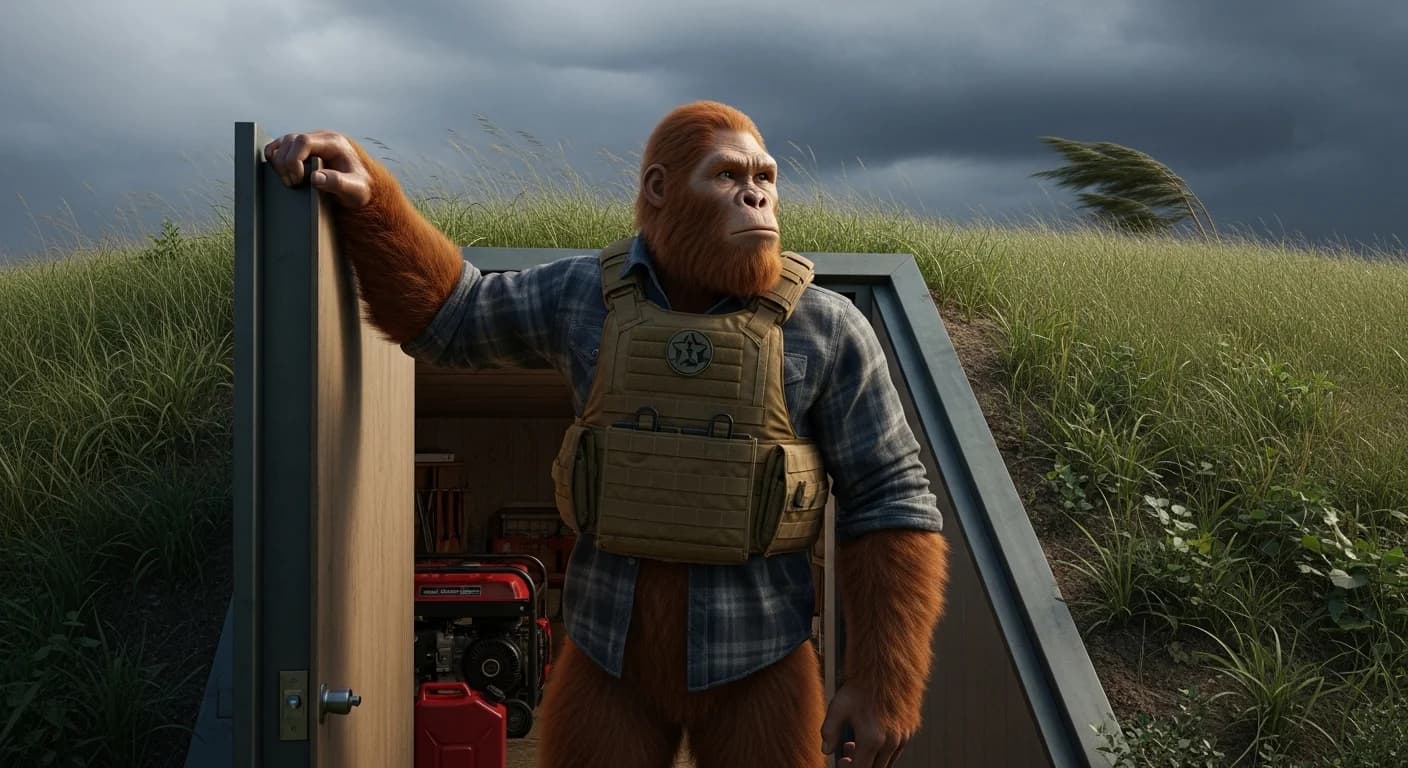
TL;DR — What happens when the grid fails
Grid failure is not one event. It is a cascade. Power goes first. Water pressure drops within hours if your municipal supply uses electric pumps. Refrigeration fails in four hours. Cell towers run on battery backup for 4–8 hours before going dark. The families who came through the 2021 Texas freeze, Hurricane Maria, and the 2020 supply disruptions intact had built the four layers before any of it started: power, water, food, and communications. This article covers what the cascade looks like in real time and what each layer of preparation actually changes.
I have been through two extended outages since building my off-grid system. My neighbors lost power for nine days in one event and eleven days in another. I lost power to the grid. My house stayed on. The difference between those two outcomes was not luck. It was 48 months of building the right infrastructure before either outage happened. The most important thing I can tell you about emergency preparedness is that it cannot be done during the emergency. The window is right now, while every component is available and no one is competing for the last generator on the shelf.
Table of Contents
- The four-system collapse cascade
- Hour 0–4: Power fails first
- Hour 4–8: Water pressure drops
- Hour 8–24: Food safety fails
- Hour 24–72: Communications go dark and security degrades
- What the 2021 Texas freeze proved
- What Hurricane Maria taught us about 84-day outages
- The preparation window is always before the event
- FAQ
The four-system collapse cascade
Grid failures follow a predictable sequence. Understanding the sequence is the first step in interrupting it.
The cascade always runs in the same order: power, then water, then food safety, then security. Each layer's failure accelerates the next. A household with no backup power loses water pressure when the electric pumps fail. Without water, food preparation becomes dangerous. Without power or communications, coordinating any kind of response becomes nearly impossible. By hour 72 in a serious outage, every system that depended on the grid is offline — and the household is in a genuine survival situation.
"The average U.S. power outage duration has increased significantly over the past two decades, with weather-related outages now lasting an average of 7.8 hours compared to 3.5 hours in 2000. Major outage events — those lasting more than 8 hours — have become three times more frequent since 2015."
— U.S. Department of Energy, Electric Power Annual, 2024
The grid is aging. The U.S. Energy Information Administration reports that the average large power transformer is over 40 years old — beyond its designed service life. The infrastructure was built for a different era of demand and a different climate. Every year, it is being asked to do more under conditions it was not designed to handle.
The failure events of the last decade are not anomalies. They are previews.
Hour 0–4: Power fails first
The moment the grid goes down, everything that runs on utility power stops. For most households, this means:
- Lighting fails immediately
- Refrigerators begin warming — they maintain safe temperature for approximately 4 hours with the door closed
- HVAC stops — in an extreme heat or extreme cold event, indoor temperature begins moving toward outdoor temperature within 30–90 minutes depending on insulation
- Sump pumps stop — basement flooding risk begins in rain events
- Medical equipment fails — CPAP, nebulizers, infusion pumps, oxygen concentrators
This is hour zero. The household that has no backup power is immediately in a degraded state.
The household with off-grid solar and a battery bank notices nothing. The lights stay on. The refrigerator keeps running. The HVAC continues. The well pump operates. Every load continues because the battery bank picked up the load before the utility failure registered on the clock.
That is what preparation actually looks like. Not survival mode. Not rationing. Continuity.
What would solar look like for your home?
Get your exact system recommendation in minutes. Panel count, battery bank size, inverter capacity, cost range — calibrated to your address, not a national average.
SHOW ME MY SYSTEM →Hour 4–8: Water pressure drops
Most households do not understand that their water supply depends on the grid.
Municipal water systems use electric pumps to maintain pressure. In a serious outage event, those pumps lose power when the grid fails. Backup generators at water treatment facilities run on fuel — fuel that runs out in extended events. The 2021 Texas freeze caused widespread municipal water system failures not from grid failure alone, but from the cascade: grid down → pumps down → pressure lost → pipes froze → pipes burst.
In a major grid event, water pressure in municipal systems typically drops within 4–8 hours. In areas with compromised infrastructure, within 2 hours.
What this means for your household:
- Toilet flushing requires stored water if pressure is gone
- Cooking requires stored water
- Sanitation — hand washing, wound care, hygiene — requires stored water
- If anyone in your household needs boiled water for medical purposes, cooking requires stored water and heat
The households that understood this had 55-gallon water storage drums filled before the event. They had gravity filtration systems that required no power. They had a well with a properly sized inverter running from the battery bank.
The households that did not understand this were calling neighbors by hour six asking if anyone had water to spare.
Hour 8–24: Food safety fails
The USDA's guidance is clear: refrigerator food is unsafe after 4 hours without power if the door has been opened repeatedly. Freezer food is safe for 24–48 hours if the door stays closed. After that, the contents must be treated as compromised.
In a 9-day outage — the kind my neighbors experienced — this means every perishable in the house is gone by day two. Anyone without stored food is now dependent on food distribution, stores, or neighbors. In a widespread outage event, stores sell out within 72 hours. This was documented precisely in March 2020: every staple food item in US retail stores depleted within 72 hours of the WHO pandemic declaration. Toilet paper, disinfectant, bottled water, canned goods, bread — gone in three days.
Food safety failure at hour 8–24 is not a hypothetical. It is a documented outcome of every major grid event in the last decade.
The households that came through these events with food security had one thing in common: they had built their food supply before the event started. Thirty days of rotated canned goods. Freeze-dried food with 25-year shelf life for the long-term base. A chest freezer that stayed closed during the outage and was powered by the battery bank long enough to preserve its contents.
🦉 WATTSON'S HARD TRUTH: "The grocery store does not know your family. When the supply chain breaks, it breaks for everyone at the same moment. The 72-hour window is not a theory — it is a documented fact from 2020, from 2021, from Maria. You are not preparing for the apocalypse. You are preparing for the event that has already happened three times in the last decade."
Hour 24–72: Communications go dark and security degrades
Cell towers run on battery backup. That backup lasts 4–8 hours before going dark in an outage. After that, cellular networks in the affected area become unreliable or unavailable — congestion from everyone trying to use them simultaneously, and no power to maintain them.
By hour 24, a household in a serious outage has no reliable communication to emergency services, to family members outside the affected area, or to any coordination network. The neighbors who need help cannot call for it. The family members who want to check in cannot get through.
At the same time, security degrades. Extended outages correlate with increased property crime. The mechanism is simple: darkness, no lights, no cameras, no ability to call for help, and 11–18 minute rural law enforcement response times that stretch further when every deputy is responding to simultaneous calls across the county.
A property that goes dark in a grid outage is advertising its vulnerability. A property that stays lit — solar panels, battery bank, perimeter lighting — is not. The light itself is deterrence.
By hour 72, the households without preparation are in an unambiguous survival situation. The households with preparation are in an inconvenience.
What the 2021 Texas freeze proved
Winter Storm Uri hit Texas in February 2021. 4.5 million households lost power. 246 people died. The outage lasted days in sub-freezing temperatures — single-digit wind chills, pipes bursting, no heat, no water, no way to keep food from freezing in homes that couldn't retain heat.
The cascade ran exactly as described above. Power first. Then water pressure as pipes froze and burst. Then food safety as households with no backup heat watched their kitchen temperatures drop below freezing. Then communications as cell networks overloaded. Then security as desperation set in.
The households that came through it without tragedy had backup power running their heat, their water pump, their communications. The difference between those households and the ones that didn't survive was not geography, not income, and not luck. It was a battery bank and a preparedness plan built before February 2021.
The time to build that plan was October 2020. The people who built it then didn't feel lucky in February. They felt vindicated.
What would solar look like for your home?
Get your exact system recommendation in minutes. Panel count, battery bank size, inverter capacity, cost range — calibrated to your address, not a national average.
SHOW ME MY SYSTEM →What Hurricane Maria taught us about 84-day outages
Hurricane Maria made landfall in Puerto Rico on September 20, 2017. 3.4 million Americans lost power. The average outage duration was 84 days. Some communities were without power for eleven months — nearly a year.
FEMA's minimum emergency preparedness recommendation is 72 hours. Maria demonstrated that 72 hours is the floor, not the ceiling. The communities that survived Maria with the least impact had built systems that didn't depend on infrastructure restoration timelines. Off-grid solar. Rainwater collection. Food gardens and preserved food supplies. Community communication networks using ham radio and satellite.
The lesson Maria taught: grid restoration timelines in a serious event are measures of failure, not milestones you can plan around. A household that waits for the grid to come back is a household that eats through its food supply, runs out of stored water, and eventually evacuates. A household with its own power generation, water source, and food supply was not waiting for anything.
Eleven months without grid power. The households that made it through independently never needed the restoration timeline. They had built inside their own perimeter.
The preparation window is always before the event
The pattern in every documented grid failure event of the last decade is the same: preparation that happened before the event produced good outcomes. Preparation that was planned but not completed produced bad outcomes.
The 2021 Texas freeze gave plenty of historical precedent — Texas had experienced similar cold weather events in 1989 and 2011 without major infrastructure improvements. The COVID supply chain failure gave years of warning in the form of just-in-time supply chain vulnerability research. Hurricane season is predictable by calendar. The grid's aging infrastructure has been documented by the DOE for over a decade.
Every event was foreseeable. None of them were prepared for by the majority of affected households.
The preparation window for the next event is right now. While generators are available. While freeze-dried food ships in normal delivery windows. While battery banks and solar panels are in stock at standard prices. Before the storm watch goes up, before the supply shelves empty, before the neighbor with a generator becomes the most popular person in a three-mile radius.
The four-layer system — power, water, food, and communications — does not have to be built all at once. Start with power. Add water. Add food. Add communications. Built in that sequence, over any reasonable timeline, the cascade that hit 4.5 million Texas households in 2021 becomes a non-event for your family.
FAQ
How long does food stay safe in a refrigerator without power?
Four hours with the door closed and not opened repeatedly. After that, the USDA recommends treating refrigerated perishables as unsafe. A full freezer maintains safe temperature for 24–48 hours. A half-full freezer for approximately 24 hours. Keep the doors closed and don't open them during the outage.
How long does water pressure stay available in a grid outage?
For municipal (city/town) water: typically 4–8 hours before pressure drops as electric pumps lose power. In events affecting large areas, faster — the Texas freeze saw municipal water systems fail within 2–4 hours in the hardest-hit areas. Well water with a submersible pump: immediately, unless the pump is connected to your off-grid battery bank.
How long do cell towers work during a power outage?
Most cell towers run on battery backup rated for 4–8 hours. In practice, many fail sooner due to battery age and simultaneous surge demand during grid events. In the Texas freeze and during Hurricane Maria, cellular networks in the hardest-hit areas were unreliable within hours of the outage beginning. Plan for no reliable cellular communication after 8 hours.
What is the minimum emergency preparedness supply every household should have?
FEMA's minimum: 72 hours of food and water for every person in the household — 1 gallon of water per person per day, plus enough stored food. A hand-crank or battery NOAA weather radio. A flashlight with backup batteries. Practical experience from Maria and the Texas freeze suggests 30 days is the real-world useful minimum. 72 hours is the floor, not the plan.
Is the grid getting more or less reliable?
Less reliable in aggregate. The DOE reports the average large power transformer exceeds 40 years of age — beyond its designed lifespan. Weather-related outages have become three times more frequent since 2015. Grid infrastructure investment has lagged demand growth for a generation. The honest assessment: reliability will not improve faster than the infrastructure replacement rate, which is currently far behind the aging rate.
The event that hasn't happened to you yet
The grid has failed catastrophically in Texas. In Puerto Rico. In California. In the upper Midwest. In coastal hurricane corridors. In every case, the outcome for individual households was determined by choices made before the event started.
You are reading this before your event. That is the preparation window. The four-layer system — power, water, food, communications — can be built in stages. The first stage is always power, because every other layer depends on it. The Solar Power Estimator sizes that first stage for your exact home and load.
My neighbors spent nine days without power in one outage and eleven days in another. I watched them from my lit house, my refrigerator running, my water pump on, my freezer intact. They were good people who knew the grid was unreliable. They just hadn't gotten around to building the backup. The difference between their nine days and my zero was not money — my system paid itself back in avoided losses inside eighteen months. The difference was the decision to stop waiting for a convenient time and start building.