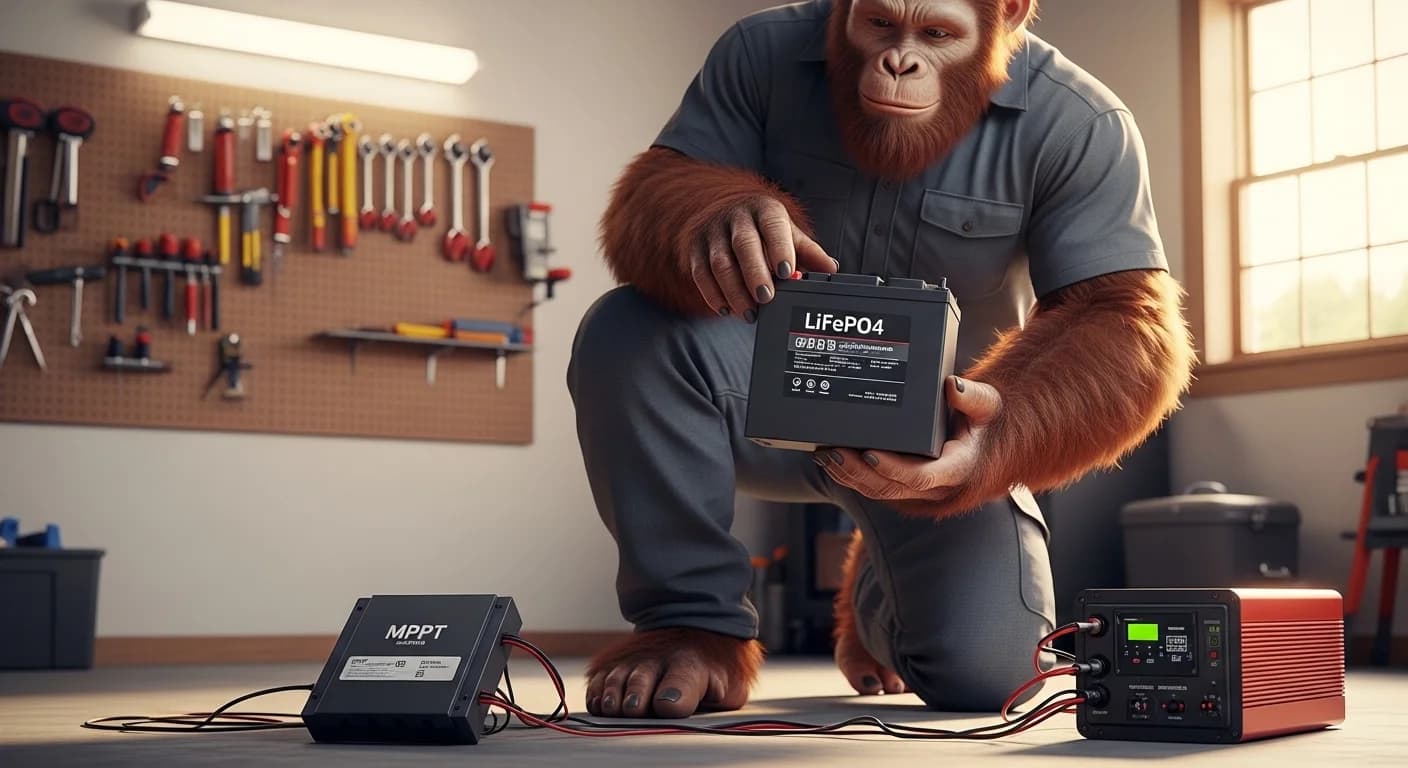
TL;DR — Home battery backup sized for real outages
Home battery backup costs between $10,000 and $30,000 installed. Essentials-only sizing at 5-10 kWh runs your fridge, lights, internet, and phones for 24-48 hours and costs $10,000-$15,000. Comfort sizing at 15-20 kWh adds a well pump and small AC, costs $18,000-$22,000, and runs 36-48 hours. Whole-home at 30-40 kWh handles central HVAC, costs $25,000-$30,000, and runs 4-8 hours on full load. LiFePO4 wins on lifespan. Solar recharging extends every scenario indefinitely.
The ice storm hit just after midnight. The substation went down at 3:14 AM. By dawn, every house on the road was dark — except one. Frank's neighbor across the road had fired up a generator at 6 AM. The noise carried for half a mile. The fumes drifted across yards. By day three, the neighbor was driving 40 miles each way to find gasoline. Frank's house ran silent. A bank of LiFePO4 batteries in his garage held twenty-eight kilowatt-hours of stored solar. His furnace ran. His freezer hummed. His insulin stayed cold. His coffee maker beeped at 6:30 AM every morning the same way it had for nine years. The grid didn't come back for three and a half days. Frank's home battery backup didn't blink once. The neighbor borrowed Frank's cordless drill on day four and asked the only question that mattered: how much.
Who this is for
This guide is for the homeowner in suburban Atlanta who watched the 2014 ice storm knock out power for a week and swore never again. The retired couple in Phoenix watching summer outages stretch from two hours to twelve. The Texas family who survived the 2021 freeze on a portable generator and burned through $400 of gasoline in four days. The Florida homeowner in Cape Coral who's done two hurricanes since installing solar panels and still lost food in both. The wildfire-zone family in El Dorado County under three-day public safety power shutoffs every August. The Ohio dad whose sump pump failed during the storm and watched the basement flood. The Vermont rancher whose well pump goes dead with the grid. The blue-collar veteran in Tennessee whose insurance just dropped him over grid instability. The new mother in Oklahoma who realized her electric breast pump doesn't work in a blackout.
For years, responsible homeowners were told blackouts were rare. Then the grid failed.
For years, homeowners were told batteries were optional. Then storm season proved otherwise.
For years, generators were the only answer. Then they ran out of fuel.
If you're tired of standing in the dark, this guide is for you. Regardless of how you voted. Regardless of how rural or urban you live. The grid doesn't discriminate when it fails. Preparedness unites.
What is home battery backup
Home battery backup is an electrical storage system that powers your home when the grid goes down. The battery bank stores energy. An inverter converts that stored DC power to the AC power your home runs on. A transfer switch automatically disconnects from the dead grid the moment it fails and routes battery power to your critical loads.
The whole system takes over in milliseconds. You usually don't notice the switch happened. The lights stay on. The fridge keeps humming. The well pump still works.
Unlike generators, home battery backup operates silently. No fuel. No exhaust. No 6 AM neighbor complaints. No standing in line at the gas station during the storm. Just power.
According to the U.S. Department of Energy, residential battery storage paired with solar qualifies for the 30% federal Residential Clean Energy Credit through 2032. Standalone battery additions also became eligible starting in 2023.
The four components
Battery bank — Stores the electricity. LiFePO4 batteries last 10-15 years and handle 3,000-6,000 cycles. Lead-acid is cheaper upfront but dies in 3-5 years.
Inverter — Converts DC battery power to AC household power. Hybrid inverters also manage solar charging and grid interconnection.
Transfer switch — Disconnects from the grid during outages and routes battery power to your home. Automatic transfer switches do this without you touching anything.
Solar panels (optional but recommended) — Recharge the battery bank during daylight. Without solar, a battery bank only buys you the time stored inside it.
WATTSON'S BACKUP TRUTH: A battery without solar is a clock that runs down. A battery with solar is a system that keeps your family alive through anything short of nuclear winter. Skip the panels and you're paying $25,000 for a glorified UPS. Add the panels and you've built energy independence.
The 5 critical home battery backup sizing mistakes
These mistakes cost homeowners thousands and leave them sitting in the dark. Learn from the wreckage.
Mistake 1: Guessing daily usage instead of measuring it
Most homeowners guess their power consumption. Guesses are always wrong. An undersized home battery backup runs out three hours into the outage.
Fix: Track actual usage with a power monitor for one month, or pull your utility bills and divide kWh by days. Most homes use 25-35 kWh per day. Critical loads only (fridge, lights, internet, well pump) usually run 5-10 kWh per day.
Mistake 2: Ignoring startup surge
Refrigerators, well pumps, AC units, and chest freezers draw 3-7x their running wattage during startup. A 1,500W well pump can pull 4,500W for two seconds when it kicks on. An inverter sized for "running loads only" will trip its overload protection and shut down at the worst possible moment.
Fix: Size your inverter for surge capacity, not continuous load. Add 50% headroom minimum. Hybrid inverters from Sol-Ark, EG4, and Schneider XW Pro publish their surge ratings honestly.
Mistake 3: Forgetting cold weather capacity loss
LiFePO4 capacity drops about 20-30% when temperatures fall below freezing. A 10 kWh battery installed in an unheated garage delivers maybe 7 kWh during a January ice storm — exactly when you need it most.
Fix: Install batteries in a temperature-controlled space, or buy heated battery models, or size 25-30% larger for cold climates. Some Renogy and Battle Born models include internal heaters that engage automatically below 32°F.
Mistake 4: Sizing for average instead of peak
Average daily usage looks reasonable on paper. Then the heat pump runs all night during the polar vortex. Then the AC pulls 4 kW for six hours during the heat dome. Average doesn't survive the worst day.
Fix: Size for your worst realistic day. Look at your highest-usage utility bill from the last two years. Build for that.
Mistake 5: Trying to power everything
Whole-home backup runs $25,000-$50,000. Essential-circuits backup runs $10,000-$15,000. Most homeowners don't actually need the central HVAC running during a 12-hour outage — they need the fridge, the well pump, the internet, and the lights.
Fix: Prioritize critical loads honestly. Fridge, freezer, well pump, lights, internet, medical equipment, phone charging, maybe a window AC unit or a space heater. Skip the dryer, the oven, the EV charger, the hot tub.
Home battery backup sizing guide
The right system size depends on what you want to power and how long you want to power it.
Essentials only — 5 to 10 kWh
Most affordable option. Powers only the critical loads that keep your family safe and comfortable.
Covers: refrigerator (1.5-2 kWh/day), LED lighting (0.5-1 kWh/day), phone and laptop charging (0.3-0.5 kWh/day), internet router (0.2-0.3 kWh/day), medical equipment if needed.
- Daily usage: 3-5 kWh
- Recommended battery: 5-10 kWh nameplate for 1-2 days backup
- Installed cost: $10,000-$15,000
- Best for: urban and suburban homeowners with short outage history
Comfort tier — 15 to 20 kWh
Mid-range option. Covers essentials plus the quality-of-life loads.
Covers everything above, plus: well pump (3-5 kWh/day depending on usage), microwave (occasional), window AC unit or space heater (4-8 kWh/day during use), washer (cold cycles only).
- Daily usage: 8-12 kWh
- Recommended battery: 15-20 kWh nameplate for 1.5-2 days backup
- Installed cost: $18,000-$22,000
- Best for: rural homes with well pumps, family homes with elderly residents
Whole-home tier — 30 to 40+ kWh
Highest cost. Runs almost everything including central HVAC.
Covers everything above, plus: central air conditioning or heat pump (15-30 kWh/day depending on climate), electric water heater (8-12 kWh/day), dishwasher, dryer (limited use).
- Daily usage: 25-40 kWh
- Recommended battery: 30-40+ kWh nameplate for 1 day backup (solar required for longer)
- Installed cost: $25,000-$30,000
- Best for: hot climates, medical necessity, work-from-home setups, large families
Home battery backup vs generator
The question every homeowner asks. Here's the honest answer.
| Factor | Home Battery Backup | Generator |
|---|---|---|
| Upfront cost | $10K-$30K installed | $3K-$15K installed |
| Fuel cost during outage | $0 (solar recharges free) | $50-$200 per day |
| Noise | Silent | 60-85 decibels |
| Maintenance | Minimal — no moving parts | Monthly testing, oil changes, fuel stabilizer |
| Startup time | Instant (milliseconds) | 10-30 seconds (automatic) or manual |
| Runtime | Limited by battery + solar | Limited by fuel supply |
| Lifespan | 10-15 years (LiFePO4) | 8-15 years (with maintenance) |
| Refueling | Automatic (solar) | Trips to gas station during the storm |
| Indoor use | Safe | Never (carbon monoxide) |
| Tax credits | 30% federal credit (with solar) | None |
Generators win on upfront cost. Home battery backup wins on everything else.
The cost gap closes fast. A $5,000 generator burning $150 of fuel per outage day, over ten years and twenty outages, costs $35,000 total. A $20,000 battery system with solar costs $20,000 and produces electricity every sunny day for two decades.
Real runtime examples
Numbers people can act on, not theoretical.
10 kWh bank, essentials only
- Running: 100W fridge cycling, 50W router, 100W in lighting, 50W in chargers
- Continuous draw: ~150W average (fridge cycles, not constant)
- Runtime: 50-60 hours on stored battery alone
- With solar recharge: indefinite
20 kWh bank, comfort tier
- Running: essentials + 750W well pump (15 min/hour) + 500W window AC (intermittent)
- Continuous draw: ~600W average
- Runtime: 28-32 hours on stored battery alone
- With solar recharge: 4-7 days depending on weather
40 kWh bank, whole-home
- Running: above + 2,500W heat pump or central AC continuous
- Continuous draw: ~3,200W average
- Runtime: 10-12 hours on stored battery alone
- With solar recharge: 1-3 days continuous depending on weather
WATTSON'S RUNTIME REALITY: Batteries alone are insurance against short outages. Batteries plus solar are independence from the grid entirely. The cabin that survived nine days of Montana blackout did it on a 20 kWh bank with 6 kW of panels. Same panels charged the same bank every day the sun showed up. The grid never came back for them in any meaningful way. They just stopped caring.
Panels. Batteries. Inverter. Charge controller.
Four components do all the work. Pick the wrong one and the whole system underperforms. The component guide walks specs that matter and specs that are marketing.
COMPARE COMPONENTS →Get the Free Solar Buyer Checklist
Every question to ask before buying any solar component — panels, batteries, inverters, and charge controllers. Free download.
GET THE FREE BUYER CHECKLIST →The real cost breakdown
Honest numbers, installed, including everything.
| Component | Essentials (10 kWh) | Comfort (20 kWh) | Whole-Home (40 kWh) |
|---|---|---|---|
| Battery bank | $5,000-$8,000 | $10,000-$14,000 | $18,000-$24,000 |
| Hybrid inverter | $2,500-$4,000 | $3,500-$5,500 | $5,000-$8,000 |
| Transfer switch + critical loads panel | $1,500-$2,500 | $1,500-$2,500 | $2,500-$4,000 |
| Installation labor | $1,500-$3,000 | $2,500-$4,000 | $3,500-$6,000 |
| Permits and inspection | $300-$800 | $500-$1,000 | $700-$1,500 |
| Total installed | $10,000-$15,000 | $18,000-$22,000 | $25,000-$30,000 |
| Federal tax credit (30%) | -$3,000 to -$4,500 | -$5,400 to -$6,600 | -$7,500 to -$9,000 |
| Net after credit | $7,000-$10,500 | $12,600-$15,400 | $17,500-$21,000 |
The federal solar tax credit applies to battery storage when installed with solar or as a standalone addition (rule change effective 2023).
Many states stack additional incentives. California's SGIP, New York's NY-Sun, Massachusetts SMART program, and Hawaii's Battery Bonus all reduce the net cost further. Check local utility programs.
Frequently asked questions
How long will a home battery backup last during a blackout? Depends on bank size and load. A 10 kWh bank running essentials lasts about 24-50 hours on stored energy alone. A 40 kWh bank running whole-home loads lasts 10-12 hours. Add solar and either runs indefinitely on managed consumption — that's the whole point.
Is home battery backup worth it compared to a generator? On upfront cost alone, generators win. On every other metric — noise, fumes, fuel cost, lifespan, tax credits, indoor safety, automatic operation — home battery backup wins. Over ten years and multiple outages, batteries cost the same or less than generators while requiring zero fuel runs during the storm.
How much does whole-home battery backup cost? Whole-home backup with 30-40 kWh of LiFePO4 storage and a properly sized hybrid inverter runs $25,000-$30,000 installed before the 30% federal tax credit. Net cost after credit lands between $17,500 and $21,000.
Can I add a battery to my existing grid-tied solar? Yes. AC-coupled retrofit batteries like Tesla Powerwall and Enphase IQ Battery work with most existing grid-tied installations. Expect $10,000-$20,000 for a retrofit. The original solar inverter stays in place.
What size battery do I need for a refrigerator and a well pump? A modern Energy Star fridge uses 1.5-2 kWh per day. A well pump on a typical residential load uses 2-5 kWh per day. Combined daily load: 4-7 kWh. With 2 days backup and 80% depth of discharge: 10-18 kWh nameplate. A 15 kWh battery covers most homes.
Does home battery backup qualify for the federal tax credit? Yes. The Residential Clean Energy Credit covers 30% of the cost of solar plus storage through 2032. Standalone battery additions (without new solar) became eligible starting in 2023. Many states add additional incentives.
How long does a home battery backup last in years? LiFePO4 batteries last 10-15 years with proper care, delivering 3,000-6,000 cycles. Lead-acid alternatives fail in 3-5 years. Lithium-ion (older chemistry) lasts 7-10 years. LiFePO4 is the current standard for residential storage.
Can I install home battery backup myself? Some plug-and-play systems (Anker Solix, Bluetti, EcoFlow) require no electrical work and can be self-installed. Whole-home wired systems require a licensed electrician, an automatic transfer switch, and a permit in most jurisdictions. The grid interconnection alone requires inspection.
What happens if the battery dies mid-outage? The system disconnects from your home, the lights go out, and the home returns to no-power state. If you have solar, the system continues charging during daylight and may restore partial power. Without solar, you're done until the grid returns.
Does home battery backup work in cold weather? LiFePO4 charges normally between 32°F and 113°F. Below freezing, charging permanently damages the cells unless the battery has internal heating. Cold weather also reduces usable capacity by 20-30%. For cold climates, buy heated battery models or install in temperature-controlled space.
Can I run a heat pump on home battery backup? Yes, but it requires a large bank. Modern variable-speed heat pumps draw 1.5-4 kW continuously in extreme weather. Twelve hours of heat pump operation needs 20-50 kWh of storage. Most homeowners size for "survival mode" (60°F instead of 72°F) rather than full comfort during outages.
Conclusion
Home battery backup is the difference between sitting in the dark and watching the storm roll past from inside your warm, lit kitchen. The technology is mature. The economics work. The tax credits cut a third off the price.
Size for your real critical loads, not a salesperson's brochure. Start at 10 kWh for essentials. Plan on 20 kWh for comfort. Build to 40 kWh for whole-home. Add solar so the bank refills every sunny day.
Generators were the answer for the last century. Home battery backup is the answer for the next one. Silent. Clean. Automatic. Tax-credit eligible. Ten to fifteen years of dependable life.
The next outage is coming. The decision isn't whether to prepare. It's which technology you trust your family to.
The complete Component Selection guide →