Last Updated: April 13, 2026
TL;DR — The Efficiency Gap
PWM controllers are cheap and reliable for very small systems, but they are incredibly wasteful for a residential off-grid home. By "clamping" your panel's high-voltage production down to 12V or 24V, you are literally throwing away the wattage you paid for. MPPT technology uses a "brain" to match your panel's sweet spot to your battery's needs. For any system over 200 watts, the extra $100 for an MPPT controller usually pays for itself in less than one winter by reducing the need for more panels.
Are you adding more panels because your system is 'slow'?
You might not have a panel problem—you might have a controller problem. If you see '300W' on your panels but only '180W' going into your batteries, you are being robbed of your harvest by a cheap PWM switch. This guide shows you how to unlock the hidden watts you already own.
Table of Contents
How PWM Works: The simple switch
Imagine a solar panel as a water pump that outputs 18 PSI, but your battery is a tank that can only handle 12 PSI.
A PWM controller works by rapidly turning a switch on and off. But to keep the tank from exploding, it forces the pump to also run at only 12 PSI. You get the volume of the water, but you lose the pressure. This loss of "pressure" (Voltage) is a loss of total power (Watts).
How MPPT Works: The smart converter
An MPPT controller acts like a perfect plumbing transmission. It takes the full 18 PSI from the pump and converts the "extra" pressure into more volume (Amps) for the tank.
If your solar panels are producing 18V at 10A (180W), but your battery needs 12V, a PWM would only give you 12V at 10A (120W). An MPPT would give you 12V at 15A (180W). You just found 60 watts of "free" energy.
MPPT controllers earn their price in winter — when cell voltage is high but battery voltage is low, they harvest power that a PWM controller simply wastes.
Why MPPT wins in the cold and the clouds
Solar panels are more efficient in cold weather, which means their voltage increases. In January, your 12V panel might be outputting 22V.
A PWM controller will still clamp that 22V down to 13.5V, wasting massive amounts of harvest. An MPPT thrives in this high-voltage environment, converting that 22V "pressure" into a torrent of current to heat your home and charge your bank before the sun goes down at 4:30 PM.
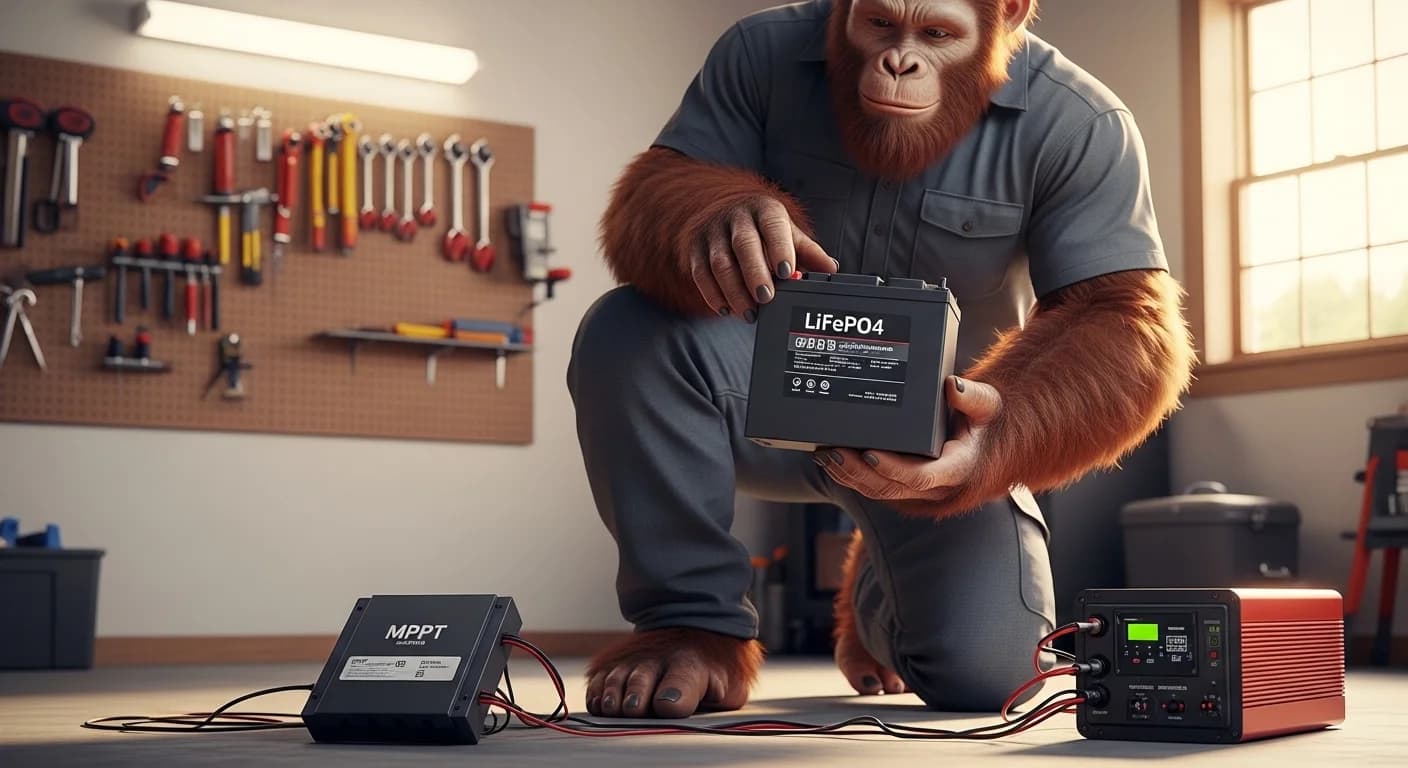
🦍 WATTSON'S CONTROLLER RULE: 'DON'T CHOKE THE PIPE.' "A PWM controller is like putting a 1/2-inch garden hose on 2-inch well pipe. It doesn't matter how much water is at the source—you're only getting what the hose can handle. MPPT is the only way to get the full flow. If your system is over 300W and you're still using PWM, you're literally burning money in the sun."
Calculating the ROI: When is MPPT worth it?
- If your system is under 200W: PWM is often fine (it's cheaper than the extra energy is worth).
- If your system is over 200W: MPPT is mandatory. The cost of a good MPPT unit (like a Victron or EPEVER) is approximately $100-$200. The cost of adding another panel to get that same 30% boost is often more expensive than just upgrading your controller once.
What would solar look like for your home?
Get your exact system recommendation in minutes. Panel count, battery bank size, inverter capacity, cost range — calibrated to your address, not a national average.
SHOW ME MY SYSTEM →Technical Trade-offs: Series vs. Parallel wiring
MPPT controllers allow you to wire your solar panels in Series. This raises the voltage to 100V or higher, letting you use much thinner (and cheaper) wires for long runs from the array to the house. By using high voltage solar strings, you minimize transmission losses and save hundreds on copper cable costs. PWM controllers generally require Parallel wiring to keep the voltage low, leading to massive efficiency losses in long wire runs.
The homesteader in Idaho watching his winter production crater. The veteran in Michigan who refuse to be dependent on a grid that fails. The father in Tennessee who knows his family's safety depends on his gear. This guide is for them.
Frequently Asked Questions
Is MPPT worth the extra money for solar?
Yes, for any system over 200 watts. An MPPT controller harvests 20-30% more energy than a PWM controller, especially in cold weather. This means you need fewer panels to do the same amount of work, saving you money on hardware and mounting infrastructure.Can I use an MPPT controller with a 12V battery?
Yes, absolutely. Most MPPT controllers are designed for 12V, 24V, and 48V battery banks. They take the high voltage from your panels (up to 150V or more) and efficiently convert it to the exact charging voltage your battery requires.Why is my PWM controller only showing half-power?
Because it IS only giving you half power. PWM controllers clamp your solar panels' voltage to the battery's voltage. If your panels are designed for 18V but your battery is at 12V, the PWM controller simply "throws away" the extra 6V of pressure.Which charge controller is better for winter?
MPPT is significantly better for winter. In cold temperatures, solar panel voltage increases. MPPT takes advantage of this extra voltage and converts it into more charging current. PWM ignores this extra voltage, leading to massive production deficits in the coldest months.What happens if my charge controller is too small for my panels?
If your controller is under-rated for the current (Amps) of your panels, it will overheat and fail. High-quality MPPT controllers have "current-limiting" features that protect themselves, but they will "clip" your extra power. Always size your controller for your maximum potential solar harvest.Efficiency is the ultimate freedom.
Going off-grid is a game of margins. When the sun is only out for five hours, you cannot afford to throw away 30% of your power harvest with a cheap switch. Invest in an MPPT charge controller. It is the single most effective hardware upgrade you can make to your system. Don't leave your power on the roof—bring it into the house where it belongs. Remember, even the best controller can't fix poor solar panel quality, so ensure your entire hardware chain is up to standard.
🦍 WATTSON ON SMART UPGRADES: "I've seen guys add four more panels to a system just because they were running low in winter. They still had a PWM controller. If they had just swapped the controller, they would have had the same power boost for half the cost and no extra mounting work. Work smarter, not bigger."
You are the architect of your own power.
You didn't build this to be a struggle; you built it to be a solution. A high-efficiency MPPT vs PWM setup is how you ensure that home runs smoothly, no matter the season. Trust the numbers, not the cheap switch.
"Have a question about a specific controller model like Victron or EPEVER for your panel layout? Our AI Guide handles those configuration details." Wattson's AI has answers →