Last Updated: April 13, 2026
TL;DR — The 'Small Part' Verdict
You spend thousands on the big gear (panels, inverters, batteries) and then try to save fifty bucks on the wiring. This is how you start a fire. Every wire in your system must have a fuse or breaker that is rated for the wire's capacity, not the load's capacity. Furthermore, a central busbar is the only way to ensure your battery bank stays balanced. This guide complements my off-grid starter kit gear list and our warning on MC4 connector safety, providing the 'shopping list' of every small part you need to finish a system the right way.
Are you looking at a 'box of wires' and wondering where to start?
You’ve seen the diagrams. They show the panel and the inverter. They don't show the fuses, the busbars, or the grounding lugs. Those are the 'forgotten' parts that Wattson sees every day in failed DIY systems. This guide gives you the definitive off-grid solar component checklist so you can buy everything once and build for the long haul.
Table of Contents
The Busbar: The central nervous system
A busbar is a thick piece of copper or brass that serves as the central point for all your positive or negative connections.
- Without it: You have five cables stacked on a single battery terminal. This leads to heat, corrosion, and unbalanced charging.
- With it: Every device (battery, inverter, charger) has a clean, dedicated path to the same electrical point. This is the only way to build a system that can be troubleshot easily.
Fuses vs. Breakers: Which goes where?
- Breakers: Best for the solar array (PV input) and the AC output. They serve as a convenient 'on/off' switch for maintenance.
- Fuses: Best for the high-amperage battery lines. A fuse doesn't have moving parts—it either works or it blows. In a catastrophic short-circuit, a fuse is more reliable than a budget breaker.
DC-side fires in residential solar systems trace back to the same two mistakes repeatedly — undersized busbars and missing overcurrent protection on the battery-to-inverter run.
Class T Fuses: Mandatory for Lithium
Lithium batteries (LiFePO4) can dump massive amounts of current (thousands of amps) in a millisecond during a short-circuit.
Standard ANL or MIDI fuses can actually 'arc over' (the air inside remains conductive) even after the fuse blows. A Class T Fuse is designed specifically to stop these massive surges and is mandatory by NEC code for modern lithium storage.
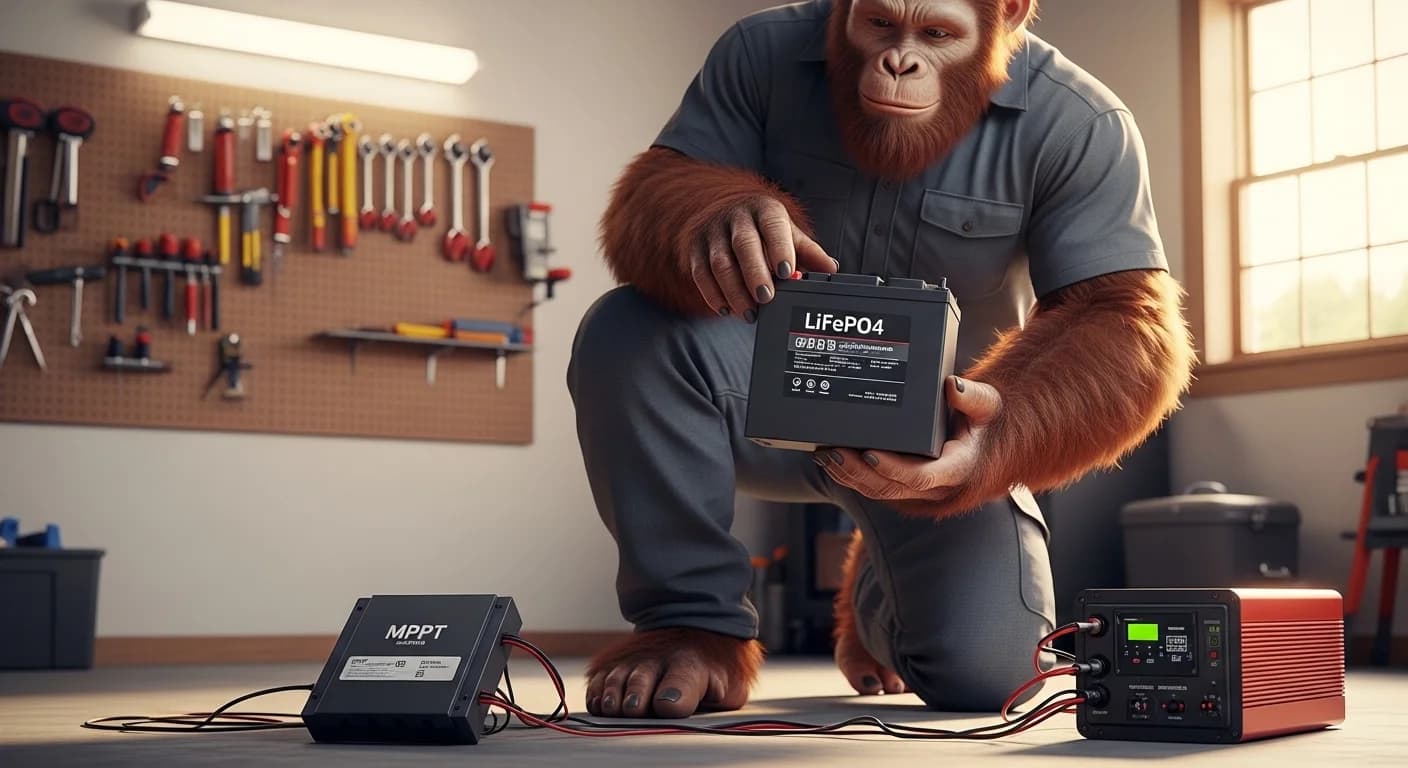
🦍 WATTSON'S COMPONENT RULE: 'IF IT CARRIES AMPS, IT NEEDS A FUSE.' "A fuse is a $40 insurance policy for a $4,000 battery. If you think you're 'saving money' by skipping the fuse, you aren't a homesteader—you're a gambler. Every positive wire that leaves your busbar needs a fuse within 18 inches of the source. If that wire chaffs and hits your frame, the fuse is the only thing standing between you and a cabin fire."
Surge Protection: Arresting the sky
I install a Midnite Solar MNSPD on the PV input and the AC output of every system.
It handles the 'transient' voltage spikes from nearby lightning. It’s a 10-minute install that has saved me from replacing three $3,000 inverters in ten years. If you live in the South or the Rockies, this is not an 'extra'—it is mandatory equipment.
The Battery Disconnect: Safety first
If your inverter starts smoking, you need a way to kill the power instantly. A heavy-duty battery disconnect switch (like the Blue Sea Systems 300A) is the emergency shut-off for your entire home. It must be accessible and clearly labeled.
What would solar look like for your home?
Get your exact system recommendation in minutes. Panel count, battery bank size, inverter capacity, cost range — calibrated to your address, not a national average.
SHOW ME MY SYSTEM →Master Component Checklist
- Busbars: (one Positive, one Negative, rated for max system Amps)
- Class T Fuse: (one for every battery bank branch)
- DC Circuit Breakers: (one for every solar panel string)
- Battery Disconnect: (heavy duty rotary switch)
- Surge Protective Device: (Midnite Solar MNSPD)
- PV Wire: (MC4-compatible, UV-rated 10 AWG or better)
- Battery Cables: (2/0 or 4/0 AWG fine-stranded copper)
- Ground Rod: (8-foot copper clad steel)
The homesteader in Idaho watching his winter production crater. The veteran in Michigan who refuse to be dependent on a grid that fails. The father in Tennessee who knows his family's safety depends on his gear. This guide is for them.
Frequently Asked Questions
What is the most important off-grid solar component?
The most important is the Overcurrent Protection (Fuses and Breakers). While panels and batteries produce and store the power, the fuses are the only components that prevent that power from starting a fire in the event of a wiring fault or hardware failure.Can I use a car fuse for my solar system?
No. Car fuses are designed for 12V and usually handle very low internal resistance. High-voltage solar strings (over 50V) require fuses with an 'AIC' (Amperage Interrupt Capacity) rating high enough to actually stop a DC arc from forming.Why do I need a busbar?
A busbar centralizes your power distribution. It allows you to connect multiple batteries, multiple inverters, and multiple chargers to the same electrical point without 'stacking' terminals, which causes heat and inconsistent charging.Is a battery disconnect really necessary?
Yes. In an emergency (like a fire or a short-circuited inverter), you need a single 'kill switch' to shut down the battery bank. Trying to unscrew a terminal while it is arcing or smoking is incredibly dangerous and often impossible.What is the best type of fuse for lithium batteries?
A Class T Fuse is the only type recommended for Lithium. Lithium batteries can deliver massive short-circuit currents that can weld standard fuses shut and keep the power flowing even after the fuse has 'failed.'The system is the details.
You didn't build this to be a struggle; you built it to be a sanctuary. Selecting the high-efficiency off-grid solar component checklist setup is how you ensure that home runs smoothly, no matter the season. Trust the fuses, not the price tag.
🦍 WATTSON ON 'STAYING POWER': "I tell my clients: buy the best fuses you can find. You only buy them once. If you never need them, they worked perfectly. If you do need them, they will be the best $40 you ever spent to save your house and your family."
You are a provider for your family's future.
You didn't build this to be a struggle; you built it to be a sanctuary. Selecting the high-efficiency off-grid solar component checklist setup is how you ensure that home runs smoothly, no matter the season. Trust the detail."
"Have a question about a specific fuse size or why your busbar is getting warm? Our AI Guide handles those troubleshooting details." Get answers from Wattson's AI →