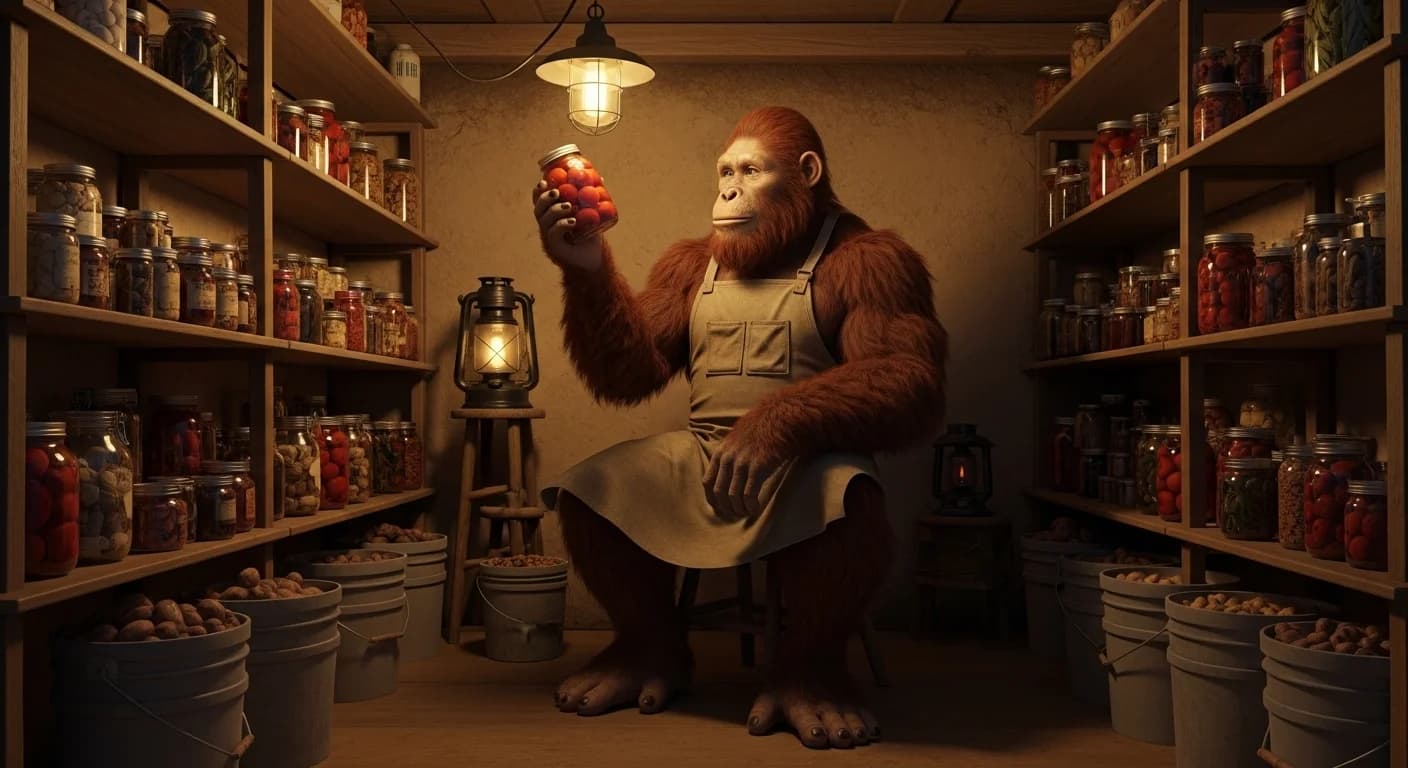
I have talked to hundreds of families about food storage over fifteen years. The ones who built a 90-day supply before they needed it describe the events that triggered their thinking the same way: something happened -- a bad storm, a supply shortage, a power outage -- and for the first time they counted what was actually in the house. The count was always lower than they expected. Often a lot lower. Three days of food is not food security. It is food proximity -- you are close to a store that has food. Food security is different. It is food you have, that does not depend on the store being open or the supply chain being normal.
Contents: What food security means . Supply chain reality . Three events . Why 90 days . Four pillars . Who needs it . Power connection . FAQ
What food security actually means
The United Nations Food and Agriculture Organization defines food security as existing when "all people, at all times, have physical and economic access to sufficient, safe and nutritious food that meets their dietary needs and food preferences for an active and healthy life."
The operational part is "at all times." Food security is not food access during normal conditions -- that is just living near a grocery store. It is food access during abnormal conditions: the 9-day grid outage, the 14-day storm recovery, the 6-week supply chain disruption, the 90-day emergency.
For a household, food security means three things:
- Stored supply: Food physically present in your home sufficient for a defined period
- Independence from supply chains: The ability to eat for that period without grocery restocking
- Nutritional adequacy: Not just surviving, but eating with adequate calories, protein, and micronutrients
Most US households achieve the first condition for 3--7 days under normal pantry conditions. Almost none achieve it for 30 days. The gap between 7 days and 30 days is the gap that documented events have repeatedly exposed.
The supply chain reality: three days of inventory
The US grocery supply chain is an engineering marvel under normal conditions. Continuous replenishment from regional distribution centers to individual stores, optimized for cost and freshness, delivers the right amount of product at the right time for normal purchasing rates.
"Normal purchasing rates" is the key phrase.
When purchasing rates become abnormal -- which happens within hours of any major emergency announcement -- the system reveals its structural limitation: the average US grocery store carries approximately 3 days of inventory at normal purchasing rates. It carries approximately 12 hours of inventory at panic-buying rates.
This is not a failure of the system. It is a design feature. Just-in-time inventory minimizes waste and storage cost. It is optimized for normal. It fails fast under abnormal.
The Wall Street Journal's supply chain reporting on the March 2020 COVID panic buy documented this precisely: staple food categories (rice, pasta, dried beans, canned goods, flour) were stripped from most major metro area stores within 36--48 hours of the pandemic declaration. The food existed -- in distribution centers and on delivery trucks. It just could not reach the shelves as fast as it was leaving them.
"Grocery store out-of-stock rates surged from a pre-pandemic 5--8% to over 30% in March 2020, with staple categories like rice, dried beans, and canned vegetables reaching out-of-stock rates above 50% in many markets."
-- FMI (Food Industry Association), The Grocery Industry Continues Delivering for America, 2020
Three events that documented the gap
| Event | Duration | Scale | What happened to households with 90-day supply | What happened without |
|---|---|---|---|---|
| COVID-19 supply disruption (March 2020) | 2--8 weeks staple shortage | National | Inconvenience. The event was observable, not participatory. | 36--48 hours to empty shelves; weeks of limited staple access |
| Hurricane Maria -- Puerto Rico (Sept 2017) | 84-day average power outage | 3.4 million people | Food security through the entire event | Federal distribution reached affected areas at 7--14 days; remote communities longer |
| Texas freeze (Feb 2021) | 4--9 days for most; longer in some areas | 4.5 million households lost power | Normal meals throughout | Store shelves emptied within 24 hours; extended food insecurity in hard-hit communities |
Each event had a different cause, duration, and scale. Each produced the same pattern: households with stored supply experienced the event as one thing; households dependent on daily grocery access experienced it as something worse.
Why 90 days is the number
The 90-day threshold is not arbitrary. It is derived from three data points:
Documented worst-case grid outage (Hurricane Maria): The average power outage lasted 84 days. Federal distribution reached most communities by day 7--14. The gap between emergency distribution availability and full supply chain restoration was 90+ days for some communities.
Supply chain restoration timelines: The FEMA emergency management framework models full regional grocery supply chain restoration after a Category 4+ hurricane at 60--90 days. A 90-day supply covers the documented worst case.
Tariff and supply disruption duration: Multi-month supply disruptions from tariff shocks, port strikes, or transportation disruptions have repeatedly lasted 60--120 days before market adjustment reduced household impact.
Seventy-two hours is FEMA's minimum recommendation. It is designed to bridge the gap until emergency services arrive -- not until the supply chain normalizes. Thirty days covers most domestic weather events and gives meaningful buffer for supply disruptions. Ninety days is the threshold at which even the documented worst cases in US history are covered.
WATTSON: "The difference between 30 days and 90 days of storage is not 60 more days of paranoia. It is the difference between covering most events and covering every event in the documented US emergency record. Build for 90 days. If the event is shorter, great. If not, you're covered."
The four pillars of food security
A complete household food security system has four components:
1. Stored supply (the buffer): Dry staples in mylar with oxygen absorbers. Freeze-dried supplemental meals. Canned goods in rotation. Shelf life: 2--30 years depending on method. This is the layer you build first because it is the most accessible, the most durable, and the fastest to deploy.
2. Water adequacy (the dependency): Every meal in a stored food system requires water. Freeze-dried food requires water to rehydrate. Home canning requires water. A 90-day food supply without a 90-day water supply is a half-built system. Water security works in parallel with food security.
3. Power reliability (the infrastructure): Refrigeration, freezer storage, dehumidification of the storage area, and food preservation equipment (pressure canner, dehydrator) all require electrical power. A grid outage that kills your refrigerator is a food loss event -- typically 3--5 days of fresh food and potentially months of frozen protein. Your solar battery bank is the infrastructure that keeps food storage functional during the events it is designed to address.
4. Production capability (the sustainability): A productive garden and livestock operation convert stored supply into a temporary buffer rather than a permanent ceiling. Seed saving, preservation skills, and ongoing food production transform 90-day food security into multi-year food independence. This layer takes years to develop -- start it simultaneously with building stored supply, but do not wait until it is complete before building stored supply.
What would solar look like for your home?
Get your exact system recommendation in minutes. Panel count, battery bank size, inverter capacity, cost range — calibrated to your address, not a national average.
SHOW ME MY SYSTEM →Who needs food security and who thinks they don't
Rural households: Average law enforcement response time in rural areas is 11--18 minutes. Average emergency distribution response time after a major event is 7--14 days. Rural households are, by geography, the last to receive emergency services and the first to be isolated by road damage, flooding, or infrastructure failure. Rural food security is not optional.
Suburban households: The 2020 COVID event documented that suburban households were not insulated from supply disruptions. The grocery stores were the same stores. The supply chains were the same chains. The shelves were stripped in the same 48-hour window. Location within commuting distance of a store does not provide food security when that store's shelves are empty.
Urban households: Harder to build large stored supplies due to space constraints. But even 30 days built from high-caloric-density foods in a small-space storage system provides meaningful buffer for the most common urban disruption scenarios (storm, grid failure, supply disruption).
Families with medical dietary needs: The household with a member requiring specific foods for diabetic management, severe allergies, or medical conditions faces a category of risk that stored general supply cannot fully address. Medical dietary needs require specific stored supply planning -- not a generic 90-day food calculator output.
The connection between power and food security
Food security and power security are not separate topics. They are the same topic from different angles.
A grid outage without solar backup:
- Refrigerator fails at hour 4--6 (fresh food safe for approximately 4 hours)
- Freezer fails at hour 24--48 (frozen food safe for 24--48 hours if unopened)
- Food loss from a single extended outage: $500--$1,500 for a typical household
A grid outage with correctly sized solar backup:
- Refrigerator continues running indefinitely on battery + solar recharge
- Freezer continues running indefinitely
- Zero food loss from any outage of any duration
The solar battery bank is not a separate purchase from the food security system. It is the infrastructure that protects the food security investment from its most common failure mode.
What would solar look like for your home?
Get your exact system recommendation in minutes. Panel count, battery bank size, inverter capacity, cost range — calibrated to your address, not a national average.
SHOW ME MY SYSTEM →FAQ
How much food does a family of four need for 90 days?
2,000--2,500 calories per person per day x 4 people x 90 days = 720,000--900,000 calories. In practical terms, approximately 200--250 pounds of dry staples (rice, beans, oats, flour) per adult, supplemented by freeze-dried and canned goods for nutritional variety. The caloric math is the first step -- do it before purchasing anything.
Is food security the same as prepping?
Food security is a logistical state. Prepping is a culture. They overlap in practice -- both involve stored food -- but the framing and motivation are different. Food security is the rational response to documented supply chain vulnerabilities and the acknowledged unpredictability of weather events. Prepping as a culture often includes elements beyond this that are not relevant to the food security question. The families most effectively implementing food security are not necessarily people who identify as preppers -- they are people who did the math and responded rationally.
What is the difference between food storage and food security?
Food storage is a component of food security. Food security is the system: stored supply + water adequacy + power reliability + production capability. Food storage alone -- dry goods on shelves -- provides a buffer during disruptions but does not constitute complete food security if the power fails and takes the refrigerator with it, or if water access is compromised and the freeze-dried food cannot be rehydrated.
How long does it take to build a 90-day food supply?
Six months is the practical build timeline for most households starting from a standard pantry. The approach: buy double of what you use each week, building a rotation layer first. Within 8--12 weeks, you have a meaningful 30-day rotation supply. Then add the archive layer (mylar-sealed dry staples) at a pace of 2--4 five-gallon buckets per month. The total cost averages less than two months of normal grocery spending at retail prices -- and becomes part of normal food spending as the rotation layer is integrated into weekly cooking.
The gap between proximity to food and having food
Most US households are food-proximate: they are near stores that normally have food. Food security is different -- it is having food, regardless of store status, supply chain state, or grid condition.
The gap between those two conditions has been demonstrated repeatedly. COVID-19 in 2020. Hurricane Maria in 2017. The Texas freeze in 2021. Each event found the same households unprepared for the same reason: they were food-proximate but not food-secure.
The 90-day supply is the threshold that covers every documented disruption in the US emergency record. Building it is a math problem, not a lifestyle statement. Ninety days of calories, stored in the right containers, in the right conditions, with the right rotation system and the right power infrastructure to protect it during outages.
The complete Food Storage guide covers every step of that build ->
In March 2020, I observed two adjacent types of households. The ones who had built anything approaching 30 days of stored supply were inconvenienced by the supply disruption in the same way a person with an umbrella is inconvenienced by rain: they got slightly wet at the margins, but the event was mostly weather. The ones who had three days of food in the house -- the default -- experienced something categorically different. I have been talking about this for fifteen years. It took a pandemic to make it legible to the mainstream. The 90-day supply is the answer to the question COVID asked.