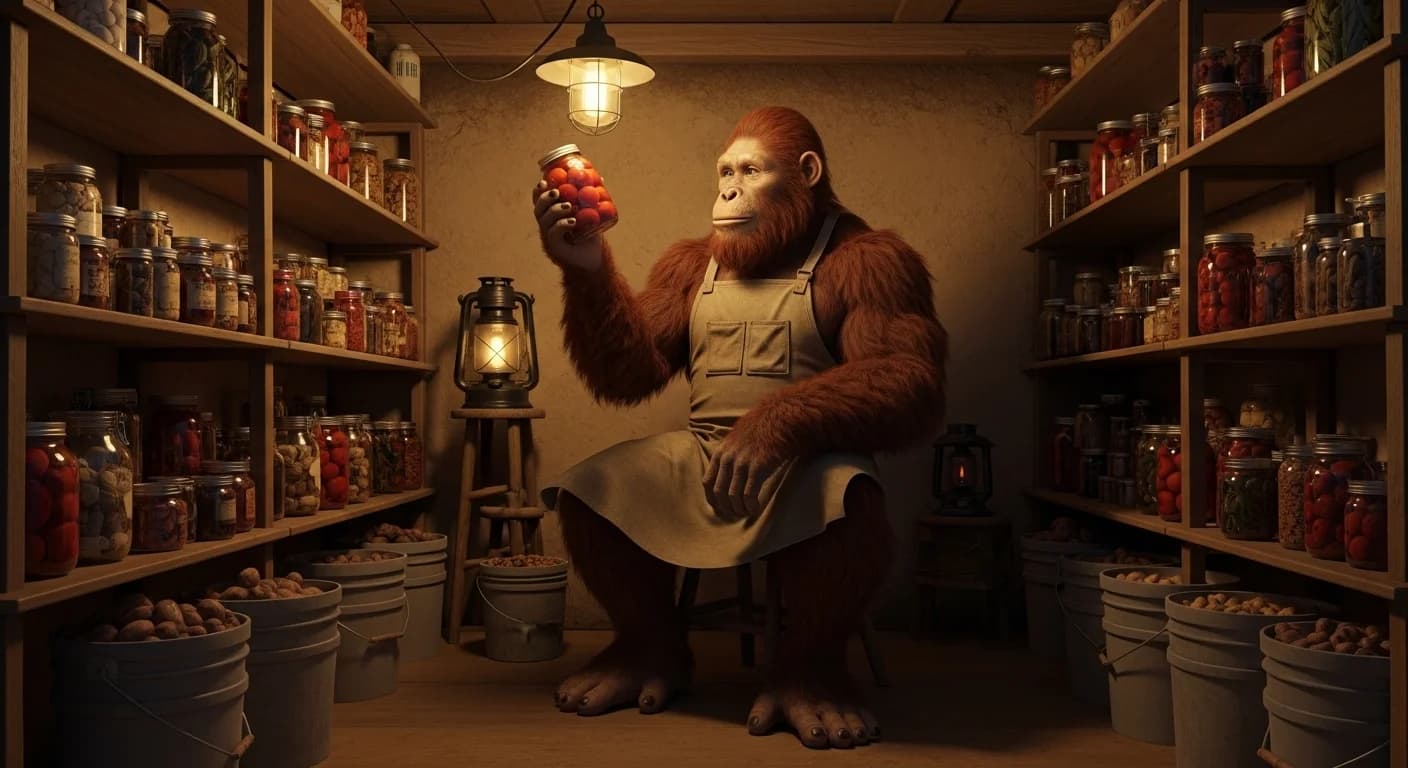
TL;DR — Off-grid food security
An off-grid property with the right infrastructure has significant food security advantages over the average suburban household: solar-powered refrigeration that doesn't fail during grid outages, a well pump that keeps running on battery backup, land that can produce meaningful food, and the rural orientation that tends to correlate with food storage mindset. This guide covers how to build the complete food security system for an off-grid or rural property — from the 90-day dry staple reserve that provides the immediate buffer to the productive land use that provides long-term independence.
Off-grid properties have a structural food security advantage that most owners underutilize. A household with a functional solar system has refrigeration that doesn't fail during grid outages — no food loss from power events. A well on battery backup has water that keeps flowing when municipal systems go down. Rural acreage can produce meaningful food rather than token amounts. The gap between having these resources and having food security is mostly organizational: building the stored supply, developing the preservation skills, and integrating food production into the property's function. This guide covers that gap.
Table of Contents
- The off-grid food security advantage
- Layer 1: The 90-day stored reserve
- Layer 2: Water for food — the dependency that surprises everyone
- Layer 3: Home food preservation — converting seasonal to year-round
- Layer 4: Productive land — garden, orchard, and livestock
- The power infrastructure that holds it all together
- Building the system in sequence
- Off-grid food security by property type
- FAQ
The off-grid food security advantage
A properly equipped off-grid or rural property has three inherent food security advantages:
Power independence: A solar system with adequate battery bank runs the refrigerator and freezer through any grid outage of any duration. The average suburban household loses $500–$1,500 of refrigerated and frozen food per extended power outage. An off-grid solar household loses nothing.
Water independence: A well on a battery-backed solar pump provides water regardless of grid status or municipal system condition. Freeze-dried food requires water to rehydrate. Home canning requires water. A 90-day food supply without a 90-day water supply is a half-built system — and municipal water pressure typically fails within 4–8 hours of a major grid outage.
Production capacity: Rural acreage, even modestly sized, can produce meaningful food yields. A 1,000-square-foot kitchen garden produces approximately 1,500 pounds of produce per season. A small laying flock (6 hens) produces approximately 1,800 eggs per year. A dozen meat rabbits operated as a breeding colony can produce 50–80 lbs of dressed meat annually from minimal feed inputs. None of these require specialized infrastructure or significant capital.
The limiting factor for most off-grid households is not land or solar capacity. It is the discipline to build the stored reserve, develop the preservation skills, and integrate food production into the property's daily operation.
Layer 1: The 90-day stored reserve
The stored reserve is the foundation — the buffer that absorbs any disruption while active production and resupply continue.
The caloric math: 2,000–2,500 calories per person per day × number of people × 90 days = your caloric storage target.
For a family of four at 2,000 cal/day: 720,000 calories. In practice: approximately 200 pounds of white rice + 150 pounds of dried beans and lentils + 80 pounds of rolled oats + 60 pounds of flour + supplemental freeze-dried + canned protein.
The storage system: Dry staples go into 1-mil+ mylar bags with correctly sized oxygen absorbers, heat-sealed, inside food-grade 5-gallon buckets with labeled lids. This system provides 25–30 year shelf life on white rice, 10–25 years on dried beans and grains, 5–10 years on oats.
Temperature is the single most important variable after container integrity. Every 10°F reduction approximately doubles shelf life. A storage area at 55°F dramatically outperforms the same containers at 75°F.
Caloric density by staple food:
| Food | Cal/lb | Lbs for 90 days (1 adult) | Shelf life (mylar) |
|---|---|---|---|
| White rice | 1,647 | ~109 lbs | 25–30 years |
| Dried pinto beans | 1,556 | ~116 lbs | 10–25 years |
| Rolled oats | 1,751 | ~103 lbs | 5–10 years |
| All-purpose flour | 1,651 | ~109 lbs | 10–25 years |
| Sugar | 1,748 | ~103 lbs | Indefinite |
| Honey | 1,384 | ~130 lbs | Indefinite |
A practical 90-day supply per adult is not 100% of any single food — it is approximately 40–45% grains, 25–30% legumes, 10–15% freeze-dried for palatability and nutritional completeness, and 10–15% fats/oils/canned protein.
Layer 2: Water for food — the dependency that surprises everyone
Every food in a stored supply requires water. This is the dependency that stops most food storage systems from functioning during the events they are designed to address.
Freeze-dried food: Requires 1–2 cups of water per serving for rehydration. A 90-day supply of freeze-dried food requires approximately 180–360 gallons of water for preparation alone, separate from drinking and sanitation needs.
Home canning: A pressure canning session requires 2–4 gallons of water. A dehydration session requires equipment cleaning. Ongoing food preservation is water-intensive.
Well pump dependency: A submersible well pump is an electric motor. Without grid power and without battery backup, it stops. Municipal pressure systems similarly fail when pumping stations lose power — typically within 4–8 hours of a major grid event.
The solution: A well pump integrated with the solar battery system runs continuously regardless of grid status. For properties on municipal water, a gravity-fed cistern filled during normal conditions and sized for 30–90 days provides the buffer. The complete water security system is covered in the food-water security article.
Layer 3: Home food preservation — converting seasonal to year-round
A productive garden and orchard produce food seasonally. Home food preservation converts seasonal bounty into year-round supply — the layer that integrates production with storage.
Pressure canning: The correct method for all low-acid foods — vegetables, meat, poultry, fish, beans, and stews. Requires a pressure canner and USDA-tested recipes. Produces 1–5 year shelf-stable foods from fresh garden produce and bulk meat purchases. This is the skill that most dramatically increases the ratio of own-produced food in the stored supply.
Water bath canning: For high-acid foods only — pH below 4.6. Tomatoes, pickles, jams, jellies, fruit, and salsa. Entry-level canning skill that most households can develop in one season of practice.
Dehydration: Lowest-cost entry point. A quality dehydrator ($60–$150) handles most fruits, vegetables, herbs, and meat (jerky). Dehydrated food at 10–20% moisture content stores 1–5 years sealed. Dehydrated mushrooms, peppers, tomatoes, and herbs are among the highest-value items to produce because of their cost at retail and low input cost from a garden.
Fermentation: The oldest preservation method. Lacto-fermented vegetables (sauerkraut, kimchi, pickles) require only vegetables, salt, and a vessel. They produce probiotic-rich preserved food for 6–12 months at room temperature and indefinitely refrigerated. Fermented foods are the preservation method that requires the least equipment.
What would solar look like for your home?
Get your exact system recommendation in minutes. Panel count, battery bank size, inverter capacity, cost range — calibrated to your address, not a national average.
SHOW ME MY SYSTEM →Layer 4: Productive land — garden, orchard, and livestock
The stored reserve is a buffer. A productive property is the replenishment mechanism. The combination transforms 90-day food security into multi-year food independence.
Kitchen garden: A well-managed 1,000 square foot kitchen garden produces approximately 1,500 pounds of vegetables per season. Prioritize calorie density and preservation potential: potatoes (high calorie, store 6 months in a root cellar), winter squash (stores 4–6 months ambient), sweet corn (easy to freeze or dehydrate), dried shell beans, and tomatoes (high preservation value — sauce, paste, canned whole tomatoes).
Food forest and orchard: Fruit and nut trees produce for decades once established. Apples, pears, and plums are the most cold-hardy and widely adaptable. Chestnuts and hazelnuts produce nutrient-dense calorie crops with minimal management. A small food forest established over 3–5 years produces meaningful food for 30–50 years without replanting.
Laying hens: The most accessible livestock. Six hens produce approximately 1,800 eggs per year — about 5 eggs per day — at a feed cost of approximately $0.25–$0.40 per egg. Eggs are a complete protein source, require minimal processing, and integrate into nearly every culinary tradition. A solar-powered coop with automatic water provides year-round production with minimal labor.
Meat rabbits: The most efficient protein-to-feed conversion ratio of any homestead meat animal. A single breeding trio (one buck, two does) produces approximately 40–80 lbs of dressed meat per year. Rabbits reproduce rapidly, can be fed on garden scraps and forage (reducing feed cost), and require minimal space and infrastructure.
The power infrastructure that holds it all together
Every component of the off-grid food security system has a power dependency:
- Refrigerator: 1,000–1,800Wh/day — cannot fail during a grid outage without food loss
- Chest freezer: 300–900Wh/day — protein storage depends on this running continuously
- Well pump: 1,500–3,000W surge, 500–1,500Wh/day operating — water for cooking, preservation, and hydration
- Pressure canner and dehydrator: 1,200–1,600W appliance loads during use
- Coop heating (cold climates): 200–400Wh/day during winter
The solar battery bank is not a separate investment from the food security system. It is the infrastructure that makes every other layer functional during the events those layers are designed to address. A grid outage that kills the refrigerator erases the protein investment in the freezer. A grid outage that stops the well pump makes freeze-dried food inaccessible and home canning impossible.
Runtime calculation for food security loads: At a conservative 3,500Wh/day (refrigerator + freezer + basic lighting), a 15kWh LiFePO4 battery bank provides:
- 15,000 ÷ 3,500 = 4.3 days without any solar input
- With daily solar recharge: indefinite runtime
A 20kWh bank provides 5.7 days without solar and indefinite runtime with normal daily recharge. This is the battery bank size that protects the food security infrastructure through any outage.
Building the system in sequence
| Phase | Timeline | Cost (estimate) | What you build |
|---|---|---|---|
| 1 — Immediate buffer | Week 1–2, under $200 | Under $200 | 72-hour emergency supply from existing pantry + 20 gallons stored water |
| 2 — 30-day rotation supply | Month 1–3, $500–$1,000 | $500–$1,000 | Canned and dry goods in active use; rotation layer established |
| 3 — 90-day archive supply | Month 3–12, $800–$2,000 | $800–$2,000 | Mylar-sealed dry staples + freeze-dried supplemental |
| 4 — Preservation skills | Ongoing from Month 3 | $150–$400 equipment | Canning, dehydrating, fermenting skills and equipment |
| 5 — Production layer | Year 1–3, $500–$3,000 | $500–$3,000 | Garden, orchard starts, small livestock |
| 6 — Power foundation | Ongoing | Varies | Solar + battery bank sized for all food security loads |
Do not wait for each phase to be complete before starting the next. Phases 1 through 3 build in sequence. Phases 4 through 6 run simultaneously. The stored supply protects you during the years it takes for the production layer to mature.
Off-grid food security by property type
Small rural lot (under 5 acres): Full garden and fruit tree production capacity. Kitchen garden can supply 30–50% of vegetable intake. No meaningful livestock beyond laying hens and possibly rabbits. Stored supply is the primary food security layer.
Small homestead (5–20 acres): Full production capacity including small livestock. Hay production for livestock feed becomes viable at 3–5 acres. Meaningful food production from land — 40–60% of caloric intake from property is achievable over 3–5 years of establishment. Stored supply bridges seasons and bad years.
Large agriculture-scale operation (20+ acres): Full food independence feasible including grain production, large livestock, and dairy. Food security becomes food independence — the property can be self-sustaining indefinitely. Still requires stored supply as buffer during establishment years and as protection against crop failures.
What would solar look like for your home?
Get your exact system recommendation in minutes. Panel count, battery bank size, inverter capacity, cost range — calibrated to your address, not a national average.
SHOW ME MY SYSTEM →FAQ
What is the most important first step in off-grid food security?
Start counting. Most households do not know how many days of food they actually have on hand. Take an inventory: count calories available in the current pantry, refrigerator, and freezer. Divide by the number of people in the household and their daily caloric needs. The resulting number is your current food security window. For most households, it is 3–7 days. Knowing the real number is the starting point for everything that follows.
How does solar power specifically improve food security on an off-grid property?
Three specific ways. First: refrigeration and freezer storage continue through any grid outage, eliminating the food-loss event that affects every grid-dependent household in extended outages. Second: the well pump continues on battery backup, providing water that makes food preparation and home canning possible during outages. Third: preservation equipment (dehydrator, canning pot with electric burner) continues operating, meaning a power outage does not interrupt preservation work during peak garden production.
Is 90 days of food storage realistic for a family on a normal budget?
Yes — and generally less expensive than two months of normal retail grocery spending when built correctly. White rice at $0.60–$0.80/lb in bulk, dried beans at $0.80–$1.20/lb, rolled oats at $0.50–$0.70/lb. These are the foundation foods in a 90-day supply. A 90-day dry staple supply for a family of four costs approximately $600–$1,200 in bulk food plus $100–$200 in mylar bags, oxygen absorbers, and food-grade buckets. Built over 6 months by purchasing double of what you use each week, the cost is nearly invisible in the weekly grocery budget.
The property that feeds itself
An off-grid property with the right system layers — stored supply, water independence, preservation skills, productive land, and the solar infrastructure that makes all of it resilient — is a property that feeds its family regardless of what the supply chain is doing.
Building that system takes 3–5 years. It does not need to be complete before it starts providing value. The stored supply provides value from day one. The preservation skills provide value in the first canning season. The garden provides value in the first growing season.
Start with the stored supply. Build the power foundation. Develop the preservation skills. Establish the production layer. In three to five years, the property's food security is a function of your land and your skills — not the grocery store's inventory.
The most food-secure household I know runs an 8-acre property in central Virginia. Solar system, well pump on battery backup, 90-day dry staple reserve, chest freezer full of home-raised meat, a half-acre kitchen garden, laying hens, and 16 quarts of canned tomatoes from last summer's harvest on a basement shelf. They have not thought about food during any news event, storm warning, or supply disruption in six years. Not because they are survivalists — they are a family with children, normal jobs, and normal lives. They are food-secure because they made a series of decisions over six years that removed the dependency. It is achievable. This is the path.