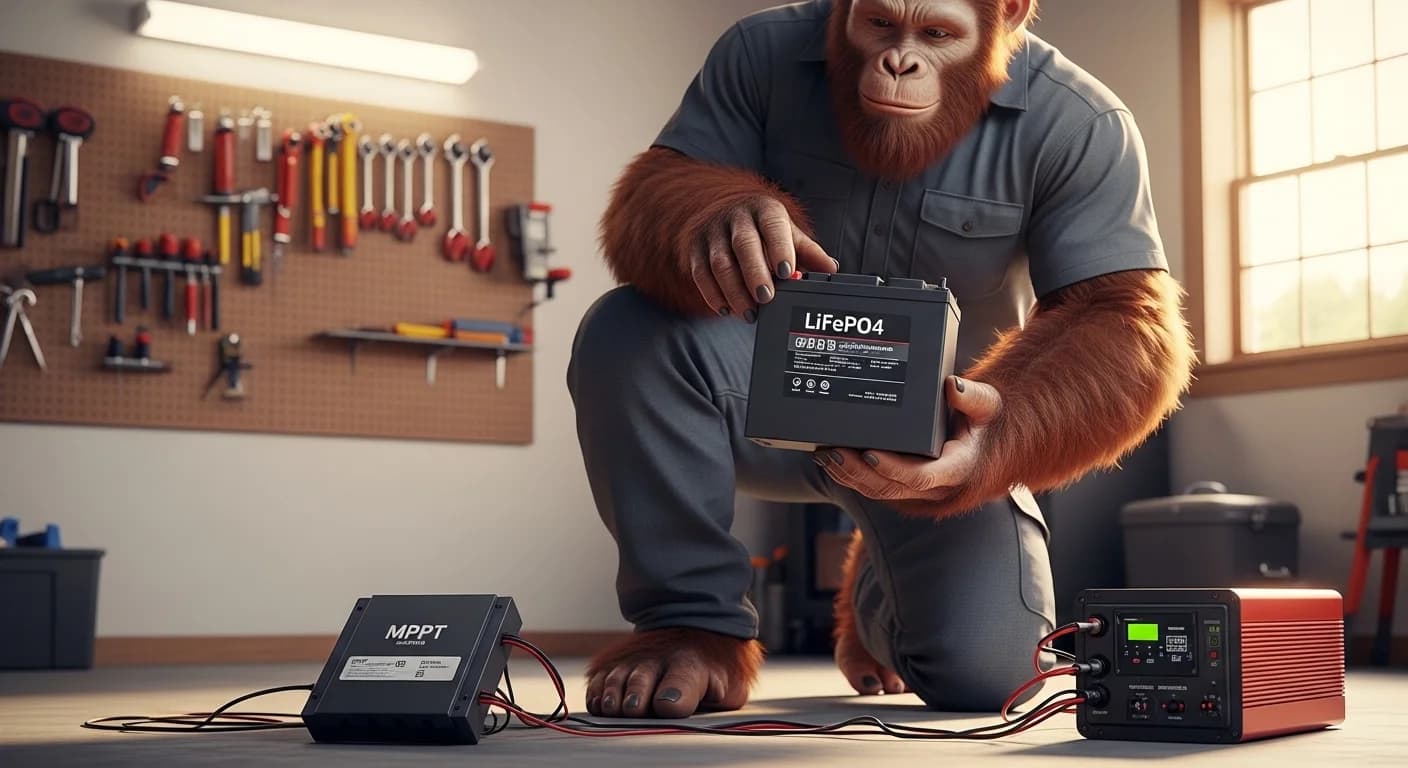
TL;DR — Inverter and converter do different jobs
An inverter converts DC battery power to AC for household appliances. A converter changes DC voltage levels between components — solar panel voltage stepped down to battery voltage, or battery voltage stepped down for 12V devices. Off-grid systems need both. Pure sine wave inverters are required for sensitive electronics including CPAPs, laptops, and refrigerator compressors. Modified sine wave costs $150 less and breaks $500 worth of gear within months. Charge controllers are specialized converters that sit between panels and batteries.
Dave bought a 3,000W inverter for his first boondocking trip in 2023. Solid brand. Good reviews. Plugged in his coffee maker at sunrise. Nothing happened. Tried his laptop charger. A faint buzzing sound. Tried his wife's CPAP machine. The display flickered and the unit refused to start. Dave drove twenty-eight miles back into town and stood in the RV supply store explaining what wasn't working. The clerk looked at his receipt and asked one question: modified sine wave or pure sine wave. Dave didn't know there was a difference. The clerk pointed to a different unit on the shelf, twice the price. Dave bought it. The CPAP ran that night. The coffee brewed the next morning. The first inverter sat in his RV cabinet for six months before he gave it to a neighbor with a kid's bunk-light setup. The inverter vs converter confusion costs RV boondockers and cabin owners hundreds of dollars every year. This guide makes sure you don't join them.
Who this is for
This guide is for the first-time RV boondocker outside Tucson who keeps reading "inverter" on Amazon and "converter" on the YouTube tutorial and isn't sure which device they need. The cabin builder in Wyoming pulling together a 48V LiFePO4 system off-grid and trying to figure out why everyone keeps mentioning a charge controller. The retired electrician in Florida who knows electrical work cold but never had to think in DC voltage levels before this hurricane prep project. The medical-equipment-dependent homeowner in Oregon whose CPAP needs reliable power and whose first cheap inverter cooked itself in three weeks. The prepper in Montana sizing components for the first time and getting lost in spec sheets. The boat owner in Maine wiring marine electronics. The Texas rancher running a remote pump station off two panels and a battery. The veteran in Tennessee who keeps almost-asking the salesperson at the solar store but doesn't want to look foolish.
For years, the off-grid community used terms interchangeably that aren't interchangeable.
For years, Amazon listings labeled converters as inverters and inverters as converters.
For years, salespeople assumed customers knew the difference.
For years, customers bought the wrong thing.
This is the guide that fixes that. Plain language. Real examples. The rule that prevents the wrong purchase.
What an inverter does
An inverter converts DC power to AC power. That's the whole job. In the inverter vs converter question, the inverter is the one that handles the AC side.
Your battery bank stores DC. Direct current. Flows one direction. The chemistry inside the cells produces it. Solar panels produce DC. Lead-acid batteries store DC. LiFePO4 batteries store DC.
Your laptop, your coffee maker, your refrigerator, your TV — all need AC. Alternating current. The same kind of power the utility grid delivers. AC switches direction 60 times per second in North America (50 times in most other regions).
Without an inverter, the energy stored in your battery bank stays locked inside the batteries. The DC can charge a phone via USB or run a 12V LED light directly, but it cannot run any standard household appliance.
The inverter is the translator. DC goes in. AC comes out. That's half of the inverter vs converter answer.
Pure sine wave vs modified sine wave
Two inverter technologies exist. The choice matters more than the price difference suggests.
Modified sine wave inverters produce a choppy, stair-step approximation of AC power. Cheap to manufacture. Works for resistive loads — incandescent bulbs, simple heating elements, basic tool motors. Fails badly with anything sophisticated. Symptoms include audible buzzing from speakers, flickering LED lights, overheating motors, and outright refusal-to-start with CPAPs, variable-speed compressors, and modern electronics.
Pure sine wave inverters produce smooth, continuous AC power that's electrically identical to grid utility power. Required for sensitive electronics. Required for medical equipment. Required for variable-speed motors. Required for anything you actually care about.
The cost difference between the two used to be 3x. It's now closer to 1.5-2x. There is no good reason in 2026 to buy a modified sine wave inverter for any real off-grid application.
WATTSON'S INVERTER TRUTH: Modified sine wave inverters exist for one reason. They are cheaper to ship from the factory. Your CPAP machine doesn't negotiate the price down. It needs clean power. Period. I've helped folks rebuild after modified sine wave cooked their compressors, their CPAPs, their pellet stove controllers. Every one of them said the same thing afterward. Should have gone pure sine wave. Spend the extra hundred and fifty dollars. Sleep well.
What a converter does
A converter changes DC voltage levels. The power stays DC. The voltage changes. In the inverter vs converter question, the converter is the one that handles the DC side.
Solar panels produce variable DC at 18-40V depending on panel size and sun conditions. Your battery bank operates at a fixed nominal voltage — 12V, 24V, or 48V. The two voltages cannot connect directly. Wiring a 40V panel straight to a 12V battery would destroy the battery in minutes.
The converter sits between them. It accepts the variable panel voltage on one side, regulates it down to the correct charging voltage for your battery chemistry, and outputs cleanly. In the off-grid world, this specific converter has a specific name: a charge controller.
Converters appear in other places too. Your 48V battery bank can't directly run a 12V LED light strip — too much voltage, the lights would fry. A 48V-to-12V DC-DC converter steps the voltage down. Your phone charger that plugs into a 12V cigarette port? That's a converter. The brick on your laptop cord that takes AC from the wall and outputs DC at 19V? Half inverter, half converter (a rectifier-converter combination).
The inverter vs converter rule is simple: converters manage everything on the DC side. They keep the various DC voltages talking to each other safely.
Charge controllers — the converter every off-grid system needs
A charge controller is a specialized converter that protects your battery bank from your solar panels. It's the most important converter in the inverter vs converter pair. It takes the variable, often-too-high panel voltage and regulates it down to the precise charging profile your battery chemistry requires.
Two technologies exist:
PWM (Pulse Width Modulation) charge controllers — simpler, cheaper, less efficient. Works for small systems under 200W. Loses energy by dumping excess panel voltage as heat. Acceptable for a small RV setup. Wrong choice for a serious off-grid system.
MPPT (Maximum Power Point Tracking) charge controllers — more sophisticated, more expensive, dramatically more efficient. Harvests up to 30% more energy from the same panels by continuously adjusting the load on the panels to operate them at peak efficiency. Required for any system above 200W. Required for cold climates where panel voltage runs high in winter.
The Victron Energy MPPT 75/15 handles small to mid-size installations reliably. The Renogy Rover series covers the budget end. Schneider, OutBack, and Morningstar dominate the professional market.
Inverter vs converter side-by-side
The clearest way to see the difference. This inverter vs converter comparison cuts through the marketing language.
| Feature | Inverter | Converter |
|---|---|---|
| Function | Changes DC to AC | Changes DC voltage levels |
| Input | 12V, 24V, or 48V DC from batteries | Variable DC (panels) or fixed DC (battery) |
| Output | 120V or 240V AC | Regulated DC at target voltage |
| What it powers | Standard household appliances | DC devices, charges batteries |
| Common examples | Pure sine wave inverter, hybrid inverter | Charge controller, DC-DC converter |
| Required for off-grid? | Yes, if running AC appliances | Yes, between panels and battery |
| Pricing range | $200 (small) to $5,000 (whole home) | $80 (PWM) to $1,200 (MPPT pro) |
Inverters handle AC. Converters manage DC. Every meaningful off-grid system needs both.
Which one you need
The inverter vs converter decision framework. Use this before you buy anything.
You need an inverter if
You're running household appliances on battery power. Coffee maker. Microwave. Blender. Refrigerator. Laptop with AC adapter. Power tools. Lighting (if you didn't wire 12V LED). Medical equipment like CPAPs. Any backup power scenario for a normal home.
You need a converter if
You have solar panels connecting to batteries (this is a charge controller — non-negotiable). You're running 12V loads (lights, fans, water pumps, fridges, refrigerator-style coolers) off a higher-voltage battery bank. You need to step a 48V system down to 12V for any DC device. You're charging USB devices directly from a battery.
Most off-grid systems need both
Solar panels make DC. Batteries store DC. Most gear runs on AC. The converter (specifically, a charge controller) sits between panels and batteries. The inverter sits between batteries and your AC loads. The inverter vs converter pair work together in every meaningful off-grid system.
Skip the converter and your panels destroy your batteries. Skip the inverter and your stored energy stays trapped in the cells.
LiFePO4. AGM. Flooded lead-acid. The choice shapes the whole system.
Battery chemistry sets your cycle life, your depth-of-discharge limits, your charge profile, and your replacement schedule. The component guide walks the tradeoffs honestly.
COMPARE BATTERIES →Get the Free Solar Buyer Checklist
Every question to ask before buying any solar component — panels, batteries, inverters, and charge controllers. Free download.
GET THE FREE BUYER CHECKLIST →A real-world off-grid setup
Here's how the inverter vs converter pieces fit together in a working off-grid system.
A 400W solar array on the roof feeds DC into an MPPT charge controller (converter #1). The charge controller regulates the variable panel voltage down to 14.4V to charge a 12V LiFePO4 battery bank. The bank stores the energy.
A 2,000W pure sine wave inverter (the inverter) connects to the battery bank and produces 120V AC. That AC powers the cabin's outlets — the fridge, the laptop charger, the coffee maker, the TV.
Inside the cabin, a small DC-DC converter (converter #2) steps the 12V battery voltage down to 5V to power a USB hub for phone charging. The 12V LED ceiling lights connect directly to the battery without any conversion needed.
That's a complete system. Two converters and one inverter. Each component does one job. None of them are interchangeable.
The 5 inverter vs converter mistakes that waste money
These inverter vs converter mistakes cost real money. Avoid all five.
Mistake 1: Buying a modified sine wave inverter to save money
You save $150 upfront and spend $500 replacing fried electronics. Or you spend that $500 on a backup pure sine wave inverter anyway. Or your CPAP refuses to run and you spend the night awake. The cheap end of the inverter vs converter spectrum costs more across the system's life.
Mistake 2: Skipping the charge controller
Connecting solar panels directly to batteries cooks the batteries within days. The panel voltage during peak sun far exceeds safe charging voltage. Without a charge controller (a converter) regulating it, the batteries overcharge and the chemistry destroys itself.
Mistake 3: Buying PWM when you need MPPT
PWM is acceptable for small systems under 200W. Anything larger and you're throwing away 25-30% of your solar production. Over the life of the system, the MPPT premium pays for itself five times over.
Mistake 4: Undersizing the inverter
Refrigerators, well pumps, and AC compressors draw 3-7x their running wattage during startup. A 1,500W inverter cannot start a fridge that runs at 200W but surges to 1,400W. Size for surge, not continuous load.
Mistake 5: Mismatching voltage between components
A 24V battery bank can't run a 12V inverter or a 12V load directly. A 12V charge controller can't handle a 48V solar array. Every component in the system must operate at compatible voltages, or you need a converter between them to bridge the gap.
Recommended equipment
Specific gear that survives real-world use.
Pure sine wave inverters
- Renogy 2000W Pure Sine Wave — solid budget option for cabins and RVs
- Victron MultiPlus-II — professional-grade, handles whole-home loads
- Sol-Ark 12K — hybrid inverter for grid-tied + battery backup setups
Charge controllers (MPPT converters)
- Renogy Rover 40A — entry-level MPPT
- Victron MPPT 75/15 — pro reliability for small systems
- Victron SmartSolar 250/100 — large array support
DC-DC converters
- Victron Orion-Tr — converts between common voltage levels
- Renogy 12V to 24V step-up — for mixed-voltage systems
Frequently asked questions
What's the difference between an inverter and a converter? An inverter changes DC to AC for household appliances. A converter changes DC voltage levels (panel voltage to battery, or 48V to 12V). Different jobs, different devices. Off-grid systems usually need both.
Do I need an inverter and a converter for my RV? Yes. The converter (a charge controller) protects your batteries from your solar panels. The inverter converts battery power to AC for your microwave, coffee maker, and laptop charger. Both are essential.
What size inverter do I need? Size for surge capacity, not just continuous load. Refrigerators surge 3-7x their running wattage at startup. Most cabins need a 2,000-3,000W pure sine wave inverter. Whole homes need 5,000-12,000W hybrid inverters.
Is pure sine wave worth the extra cost? Yes, especially if you have any sensitive electronics, medical equipment, or variable-speed motors. Modified sine wave inverters cause buzzing, flickering, and outright equipment failure. The pure sine wave premium pays for itself the first time you avoid replacing a damaged appliance.
What does a charge controller do? A charge controller is a specialized converter that sits between solar panels and your battery bank. It regulates the variable panel voltage down to safe charging levels and prevents overcharging. No off-grid system is complete without one.
MPPT or PWM for my off-grid system? MPPT for any system above 200W. PWM only for small RV setups or trickle charging. MPPT harvests up to 30% more energy from the same panels.
Can I use an inverter as a converter? No. They do completely different jobs. An inverter changes DC to AC. A converter changes DC voltage levels. You cannot substitute one for the other.
How do I know if my system needs a converter? Every system with solar panels needs a charge controller (a type of converter). Every system that mixes voltage levels (48V batteries running 12V loads, for example) needs additional DC-DC converters between the components.
Why do some sources call a charge controller an "inverter"? Mislabeling and marketing confusion. A charge controller is not an inverter — it regulates DC voltage on the panel-to-battery side. The inverter handles DC-to-AC conversion on the battery-to-load side. They are different components doing different jobs.
Can I run a CPAP machine on a modified sine wave inverter? Usually not. Most modern CPAPs detect the choppy waveform and refuse to start. Some run but damage themselves over time. Always use pure sine wave for medical equipment.
Conclusion
The inverter vs converter question has a simple answer. Both. Most off-grid systems need both, and they do different jobs in the same system. An inverter changes DC battery power to AC for your household appliances. A converter changes DC voltage levels — most commonly between your solar panels and your batteries, where it's called a charge controller.
Skip the inverter and you can't run any AC appliances. Skip the charge controller and your panels destroy your batteries. The inverter vs converter relationship is complementary, not competing.
Buy pure sine wave for the inverter. Buy MPPT for the charge controller. Size for surge, not continuous load. Match voltages across the system.
The inverter vs converter terminology trips up first-time off-gridders. The fix is permanent. Read this once, internalize it, and you'll never buy the wrong device again.
The complete Component Selection guide →